
Alla Biennale di Venezia 2026, sarà visitabile fino al 22 Novembre il Padiglione Nazionale dell’Estonia. Presso un’ex-chiesa, dove oggi funziona un centro sociale dei salesiani, Merike Estna ha installato i propri dipinti. La mostra, curata da Maria Arusoo, s’intitola The house of leaking sky. La sede è parecchio insolita, perché al soffitto affrescato nel Novecento corrisponde il pavimento piastrellato, in cui servono le linee per i due tabelloni della… pallacanestro! Merike Estna ha progettato di rimanere a Venezia per tutta la durata della Biennale, rivisitando le proprie pitture. Addirittura lei ad Agosto coinvolse gli studenti d’un master in arte contemporanea, dall’Estonia. Sull’ex-chiesa del padiglione non bazzicano mai i turisti. Anzi si conferma il tema estetico del pittore senza opera, se quest’ultima deve continuamente aggiornarsi in laboratorio, poiché è scarsamente noto il nome di chi lasciò l’affresco sul soffitto… Esteticamente, a Merike Estna interessa sintonizzarsi con la dimora. D’altronde sulla tela bianca i pigmenti si filtrano perché affiori una figura. Noi potremo immaginare, sintetizzando i due ambiti, che il quadro si svilupperà arieggiando sull’installazione. Con la dimora, bisogna familiarizzare. E’ l’unico ambiente in cui di notte non temiamo di perderci, in assenza d’una luce. Simmetricamente, la colorazione “prende fiducia” in uno svelamento per un eccessivo candore, dalla tela.
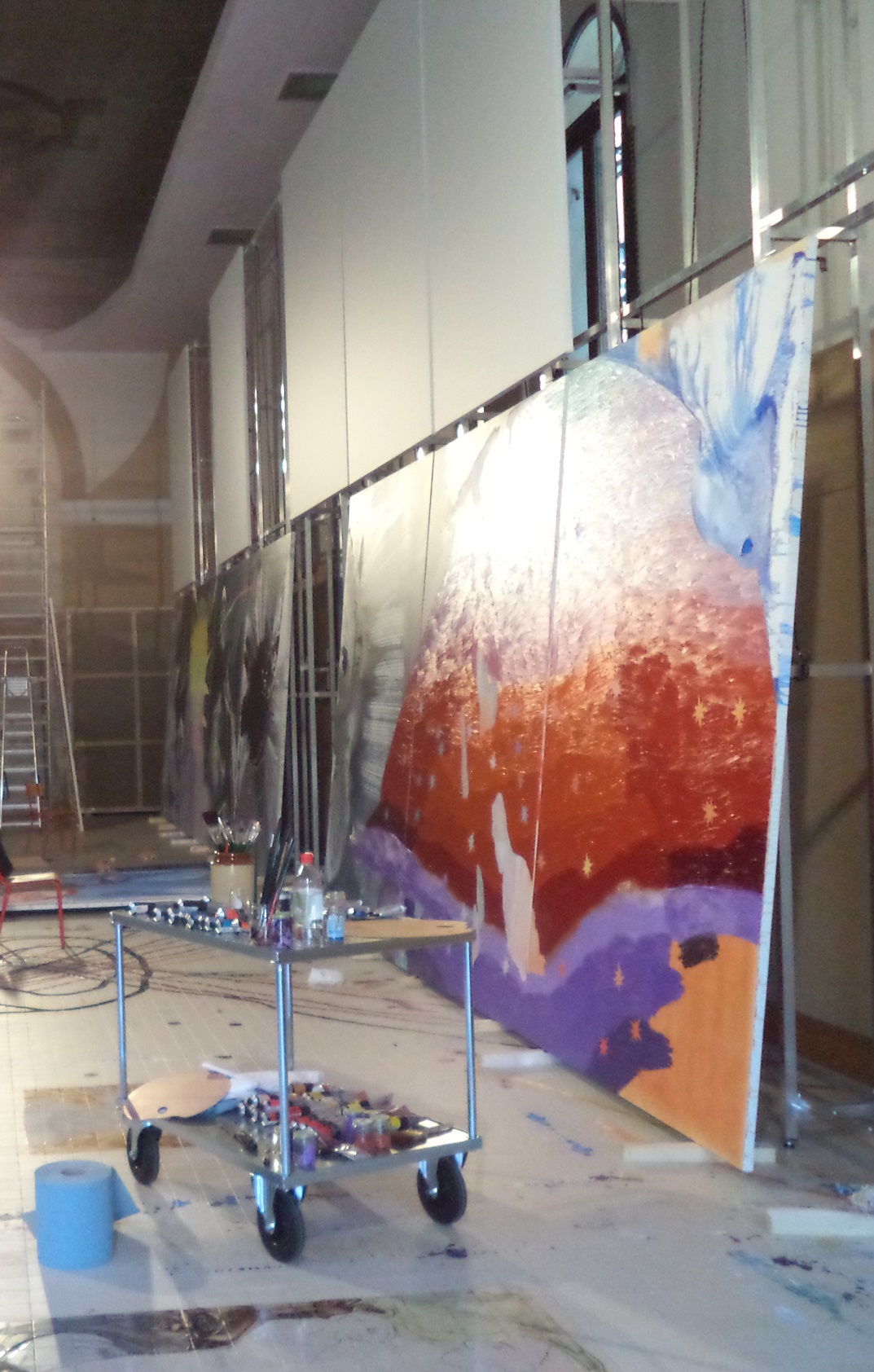
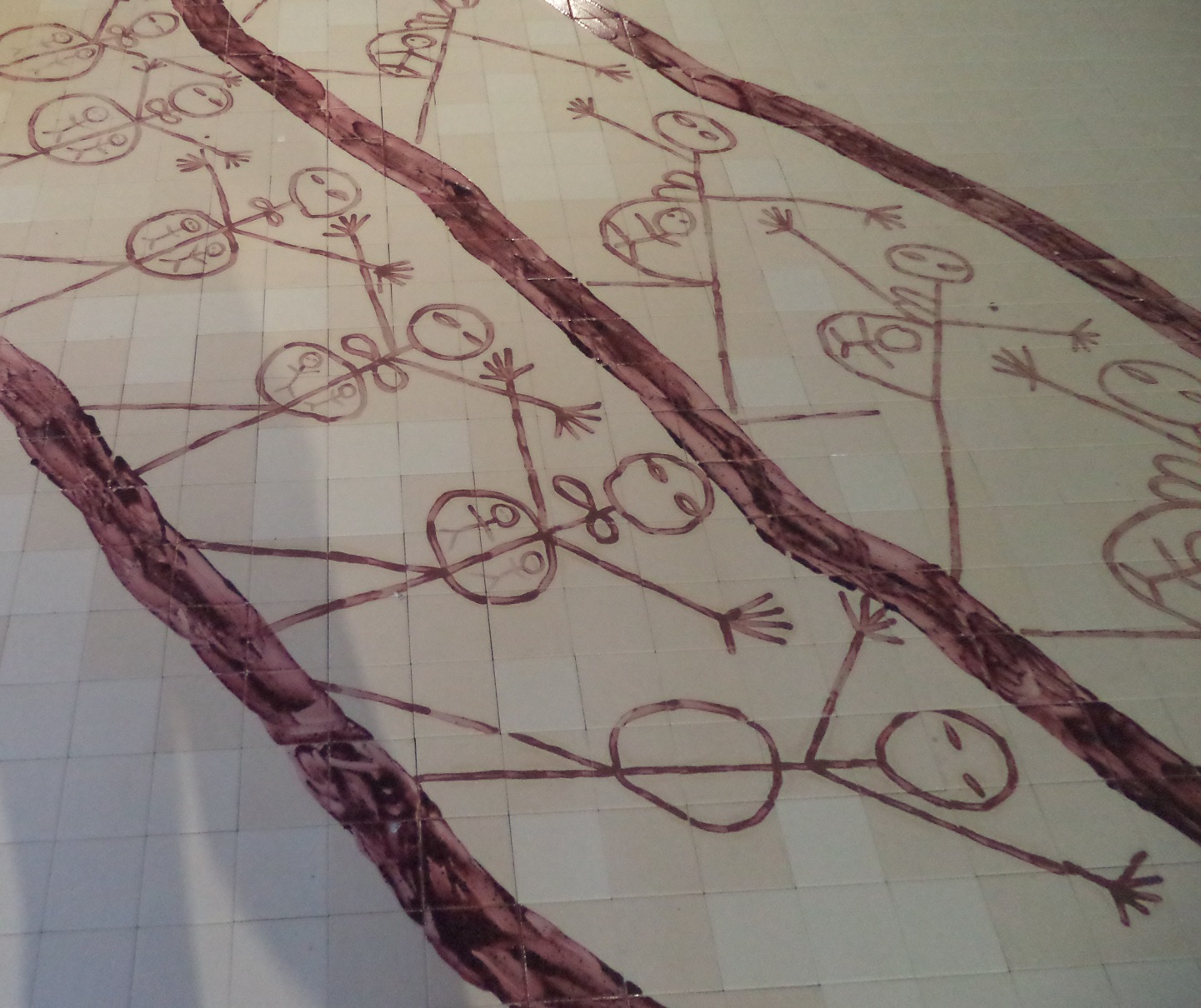
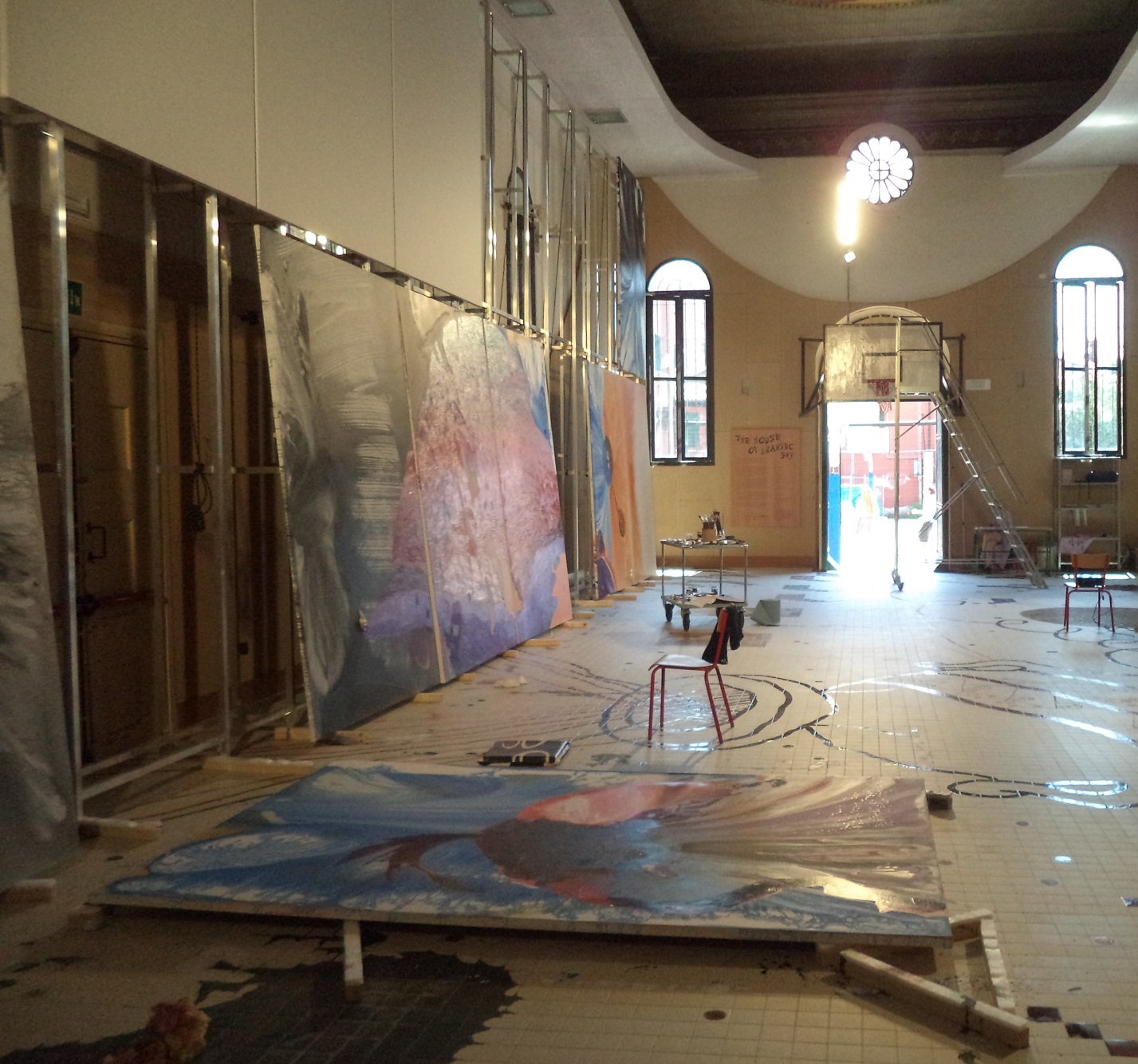
Ci sono gli scaffali con gli “strumenti del mestiere”. Ma quanto le opzioni estetiche diventeranno troppe, ergo anche in disordine? Merike Estna cerca l’action painting direttamente sul pavimento, che simboleggia una dimora per la tela, familiarizzando con questa. Il campo da gioco ha necessariamente delle linee. Ma nell’opera d’arte il bozzetto preparatorio è sempre dimenticato. Contro questa “ingiustizia”, Merike Estna dipinge addirittura sintonizzando i movimenti del suo corpo sugli abiti d’una collega, la stilista Lilli Jahilo. Genericamente, funzionano le taglie. C’è il particolare della gorgiera affinché le piastrelle “arieggino”, alla comunanza dei toni bianchi, od irradiando all’action painting una moviola per il tiro del pallone sul canestro. Aveva collaborato il Diogo Passarinho Studio, in merito ad una corretta scenografia per l’assemblaggio delle tele, rispettando il vincolo per un edificio storico. Alzandole in verticale, gli pseudo-ponteggi potrebbero progredire verso un colonnato di divisione, fra due navate. Così l’action painting partirà dall’acquasantiera. Oppure un leggio sull’ambone “arieggerà”. Dal titolo della mostra veneziana, se il Sole fosse una casa, allora esso esploderebbe (irradiando) dal tetto che gli dà la Terra, col cielo. Infatti a Merike Estna interessa dipingere pure sulle “false nuvole” delle piastrelle per il pavimento. Riguardo all’iconografia, vale il tema della maternità. La navata è comunque un “grembo”. La religione cristiana accetta il messianesimo. Più laicamente, nella storia la donna fu protetta attraverso il lavoro domestico (quantunque questo le avesse impedito una vera emancipazione). Sulle piastrelle compaiono delle stilizzazioni umane, in serie. Sociologicamente, quanto varrà il folklore per la donna incinta? La natura evolve dalle mutazioni genetiche. Le stilizzazioni avrebbero gli allacciamenti d’una catena per il DNA.
A livello estetico, nei vari dipinti si percepisce un surrealismo per l’espressionismo. Accade un po’ lo stesso in una mitologia, quando si sedimentano dei racconti che distinguono un canone linguistico. L’allestimento spinge il visitatore a passare dalle scale ai pannelli. Il grembo dà all’espressionismo del corpo arrotondato un vitalismo oltre il surrealismo, perché la nascita è comunque miracolosa, rispetto alla netta maggioranza degli elementi inorganici, nell’Universo. Merike Estna avrebbe costruito il matroneo per l’ex-chiesa. Pare che tante figure sboccino, per cui gli organuli cellulari dovrebbero trattenere melodicamente gli stridii fra le canne dell’organo. Affinché un’impalcatura si percepisse sia surreale sia espressionistica, servirebbe che essa fiorisse, forse. Il canestro s’accompagna al tabellone; la rete scomposta dal pallone sarà riordinata da una “fuoriuscita” delle cifre digitali. La figura della stellina si farebbe intercettare dagli occhi d’un rapace. Per andare a canestro, serve orientarsi con un’ottima mira. Il vecchio intonaco sui muri dell’ex-chiesa sarà stato “snocciolato”, o “sgranocchiato”, all’espressionismo rivitalizzante: per evitare di tumulare i detriti da un convogliatore. Se la navata avesse avuto una volta arcuata, allora per distorcerla noi avremmo usato la scala d’una betoniera. Ma quanto la figura del nocciolo si percepirebbe alla legnosità vegetativa per una stella? La tavolozza di Merike Estna si ridurrà per concentrazione in un occhio, con le ciglia da strappare, agli anelli d’un quaderno per gli appunti. Ci si appende sempre ai “ponteggi” delle proprie intuizioni. Si lotta artisticamente contro il “falsopiano” inutile della pagina (o tela) bianca, quando lo “accartocciamo” nervosamente perché non siamo soddisfatti dalle comodità d’una vita “normale”. Merike Estna raffigura una nave da crociera capace di cullare dalla “proboscide” del fumaiolo. Noi non sogneremmo mai che il Paradiso affondasse di ceneri. La proboscide per l’elefante è multifunzionale. La beatitudine permette di non abbisognare di nulla. C’entra ovviamente l’etimologia per la parola < navata >.
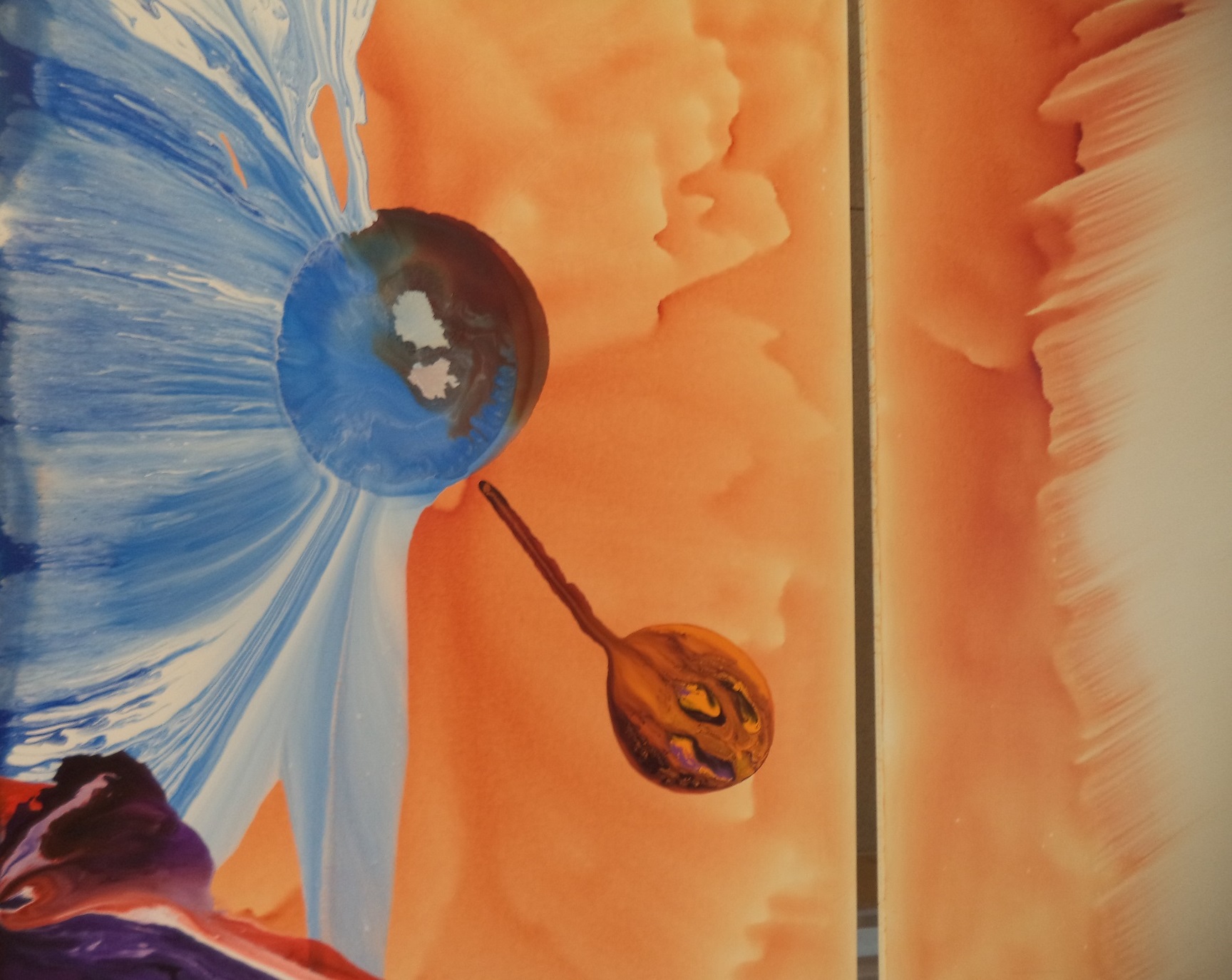
James Schuyler descrive poeticamente la pioggia che cade lungo un canestro da basket, montato sul garage. Così il tabellone si farà rigare in aggiunta, dalle “scie” di ruggine. Alla fine, il rosso ferroso si mischierebbe al blu acquoso, andando virtualmente “a canestro” sul viola d’una pervinca. Merike Estna raffigura la grotta che sa rimuovere l’abisso, mediante i tentacoli d’una medusa. Noi nasciamo schiacciando virtualmente un muro: in grembo, dalla placenta. Merike Estna lavora in una chiesa abbandonata, dove la riqualificazione resta imprevedibile a causa degli strisci che le scarpe dei cestisti lasciano sul pavimento. Forse si percepirà (non)esteticamente l’action sweating… Per Marco Calamai, il basket è l’unico sport di squadra che, nella sua interezza, tende al cielo. La sottolineatura cresce d’importanza, se rapportata al fatto che l’uomo per vivere s’abitua troppo alla terra. Però chi mira al Paradiso perde progressivamente la fatica, col suo sudore. Merike Estna avrebbe raffigurato il meteorite a scarpa. C’è la dialettica fra la direzione ed il disordine. In alcuni pannelli dominano i toni della fuliggine; ma positivamente si potrebbe percepire una radiografia fetale. Ricordiamo che Venezia poggia su una sorta di “foresta capovolta”, dai tronchi sommersi. Allora la tavolozza di Merike Estna ricorrerà al grigio-nero per la “resurrezione” d’una linfa legnosa.
A BASKETBALL FROM BELOW WITH THE HULL AND FROM ABOVE WITH THE MATRONEUM
At the Venice Biennale 2026, we will visit until 22 November the National Pavilion of Estonia. Inside an ex-church, where today a community center of Salesians functions, Merike Estna installed the own paintings. The exhibition, curated by Maria Arusoo, is called The house of leaking sky. The location is very unusual, because there is a correspondence between a tiled floor and a frescoed ceiling in the twentieth century, where the lines are necessary for the two backboards of the… basketball! Merike Estna projected to remain in Venice for the entire duration of the Biennale, revisiting the own paintings. Even in August she involved the students of a master in contemporary art, from Estonia. Inside the ex-church of the pavilion the tourists never haunt. Rather the aesthetic theme of a painter without work is confirmed, if this one has continually to be updated in the laboratory, because the name of the man who left the fresco is little known… Aesthetically, Merike Estna is interested in a syntonization with a dwelling. After all, on the white canvas the pigments are filtered in order that a figure emerges. We could imagine, synthesizing the two ambits, that the picture will be developed airing out on the installation. With a dwelling, we have to familiarize. This is the only one environment where at night we don’t worry about losing our way, when the light is lacking. Symmetrically, the coloration “has confidence” in an unveiling of an excessive whiteness, from the canvas.
There are the shelves with the “stock-in-trade”. But how much will the aesthetic options become too much, so also in disarray? Merike Estna looks for an action painting directly on the floor, which symbolizes a dwelling for the canvas, familiarizing with this one. The playing field has necessarily some lines. But in an art work the preparatory sketch is always forgotten. Against this “injustice”, Merike Estna even paints tuning the movements of her body in the clothes of a colleague, the fashion designer Lilli Jahilo. Generically, the sizes function. There is the detail of a gorget so that the tiles “air out”, at a commonality about the white tones, or radiating at the action painting a slow motion for the shot of the ball on the basket. The Diogo Passarinho Studio collaborated, about the right scenography for the assembly of the canvases, respecting a restriction for a historical building. After those were raised vertically, the pseudo-scaffoldings could progress towards a colonnade which divides, between two naves. So the action painting will start from a stoup. Or a bookstand on the ambon “will air out”. From the title of the exhibition in Venice, if the Sun was a house, so it would explode (radiating) from the roof given there by the Earth, with the sky. In fact Merike Estna is interested in painting also on the “false clouds” of the tiles for the floor. About the iconography, the theme of the maternity is valid. The nave is however a “womb”. The Christian religion accepts the messianism. More secularly, in the history the woman was protected through the domestic work (although this one impeded her from becoming really emancipated). On the tiles some human stylizations in a series appear. Sociologically, how much will a folklore for the pregnant woman will be valid? The nature evolves from the genetic mutations. The stylizations would have the connections of a DNA chain.
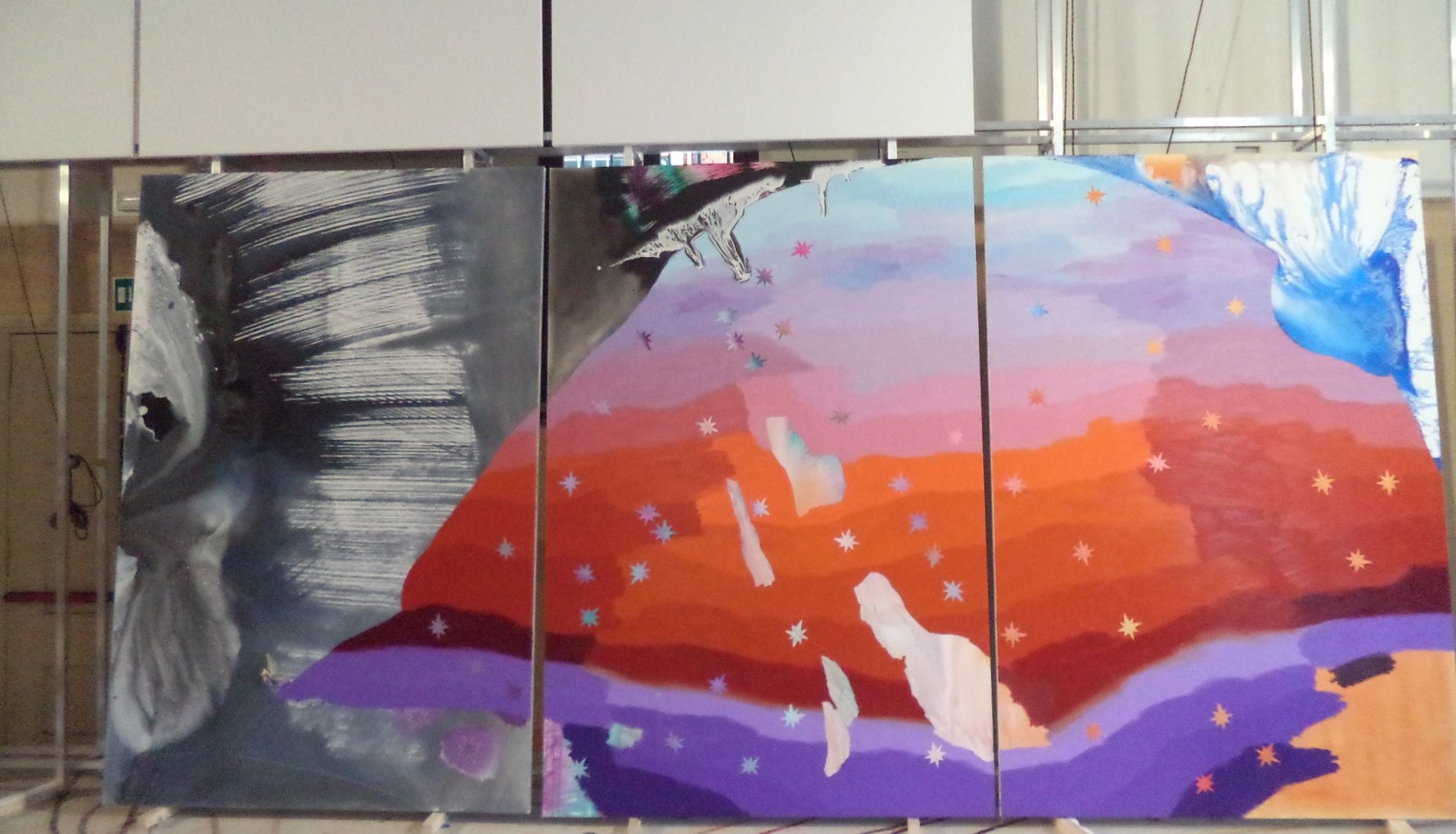
At the aesthetic level, in the different paintings we perceive a surrealism for the expressionism. It happens a bit the same for a mythology, when some stories are sedimented and they distinguish a linguistic standard. The staging leads the visitors to pass from the ladders to the panels. The womb gives a vitalism beyond the surrealism to the expressionism of the rounded body, because the birth is however miraculous, compared to the clear majority of the inorganic elements, in the Universe. Merike Estna would have built a matronuem for the ex-church. It seems that many figures blossom, therefore the cellular organelles should hold melodically the screeches between the pipes of an organ. In order that a scaffolding is perceived both surreal and expressionistic, perhaps it should become an inflorescence. The basket is accompanied by a backboard; the net disordered by the ball will be reorganized by a “leakage” of the digital digits. The figure of a little star would allow its interception by the eyes of a bird of prey. To shoot a basketball, we need to orient ourselves with a good aim. The old plaster on the walls of the ex-church would have been “pitted”, or “crunched”, at an expressionism which revitalizes: to avoid that the debris from a conveyor is buried. If the nave had an arcuate vault, so to distort it we would have used the ladder from a concrete mixer. But how much would the figure of a pit be perceived at a vegetative woodiness for a star? The palette of Merike Estna will be reduced for a concentration in an eye, with the eyelashes in need of being torn, at the rings of a notebook for the notes. We always hang on the “scaffoldings” of the own intuitions. We struggle artistically against the useless “slight slope” of a white page (or canvas), when we crumple it nervously because we are not satisfied with the comfort of a “normal” life. Merike Estna represents a cruise ship able to cradle by the “proboscis” of a funnel. We would never dream that the Paradise sank with the ashes. The proboscis for an elephant is multifunctional. The beatitude allows that we don’t need anything. Of course the etymology for the word < nave > becomes relevant.
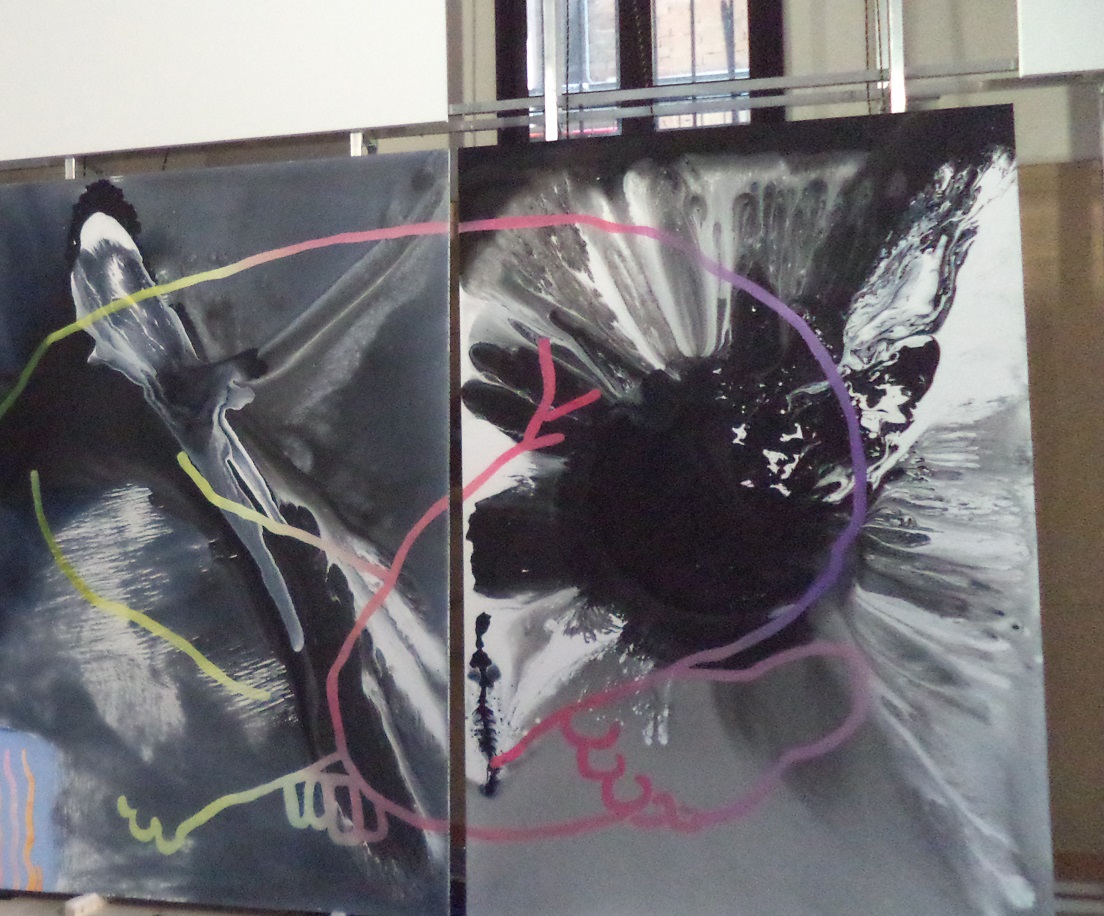
James Schuyler describes poetically the rain that falls along the basketball hoop, assembled on the garage. So the backboard will be streaked furthermore, by the “trails” of rust. Finally, a ferrous red would be mixed up with a watery blue, going virtually to take the ball “to a hoop” on the violet of a periwinkle. Merike Estna represents a cave that is able to remove an abyss, through the tentacles of a jellyfish. We were born virtually squashing a wall: in the womb, from the placenta. Merike Estna works in an abandoned church, where the urban renewal remains unpredictable due to scratches left on the floor by the shoes of the basketball players. Perhaps we will perceive (not)aesthetically an action sweating… According to Marco Calamai, the basket is the only one team sport which, in its entirety, tends to the sky. The underlining grows in importance, if we connect it with the fact for which a man for his living becomes too much accustomed to the ground. But somebody who aims at the Paradise loses progressively the fatigue, with its sweat. Merike Estna would have represented a meteorite for a shoe. There is the dialectics between the direction and the mess. In some panels the tones of the soot prevails; but positively we could perceive a foetal radiography. We remember that Venice is based on a sort of “overturned forest”, by the submerged trunks. So the palette of Merike Estna will resort to the grey-black to a “resurrection” of a woody sap.

Paolo Meneghetti

Be First to Comment