In questo lavoro presentiamo Una guida alla pubblicazione internazionale. Questa analisi intende guidare il lettore alla comprensione del meccanismo di pubblicazione della ricerca internazionale nelle principali riviste di settore che costituiscono il benchmark universale della ricerca scientifica.
Introduzione
Scrivo questo articolo in lingua italiana, perché so molto bene che un testo simile può avere uno scopo principalmente per persone come me, ovvero che hanno iniziato a studiare in Italia completamente all’oscuro di come funziona il sistema editoriale scientifico che è alla base di ogni carriera universitaria e simil-universitaria (think tank etc.) all’estero, dove con ‘estero’ intendo un limitato numero di stati che fanno capo principalmente (ma non esclusivamente) al sistema anglo-americano (USA, UK etc.) o europeo-continentale (Germania, Olanda, Polonia etc.). Infatti, un preciso percorso meritocratico, ovvero fondato principalmente su fatti misurabili, è appannaggio di pochi Paesi. Non starò qui a sostenere in quale contesto l’Italia si situi e lascio decidere al lettore da che parte stare. Ma quale che sia la sua parte, sarà potenzialmente interessato a scoprire come funziona il meccanismo scientifico di pubblicazione, che è fatto di regole precise e misurabili.
Da Heidegger, il Destino della Metafisica Occidentale non sembra tanto l’aver “ridotto” l’Essere ad un ente particolare. Questo identificherà l’idea di Platone, il motore immobile di Aristotele, la res cogitans di Cartesio ecc… Piuttosto, il Destino della Metafisica Occidentale si compirebbe avendo “esagerato” l’Essere. Servirà “caricarvi” il potere d’un ente particolare, ed essenzialmente per lo strutturalismo in politica. Heidegger menziona il “mistero” d’un cammino verso il linguaggio. Forse egli ci chiede di rimpiazzare la politica, e mediante l’estetologia. Solo quest’ultima è percepibile mettendo la creatività prima della libertà. Precisamente, l’estetologia vale nella sua formatività. La creatività presuppone il potremmo, per cui uno si limita da solo, verso un servizio agli Altri, senza la necessità dell’autogiustificazione (mediante la “banalità” d’un potere).
Da Heidegger, ci ricordiamo la dialettica fra il Welt e la Erde. Il primo identificherà il Mondo (per il concettualismo del potere); la seconda rinvierà alla Terra (da un “lirismo” del potremmo)[1]. Forse, l’ontologismo di Heidegger va filtrato tramite il vitalismo di Deleuze. Se la filosofia è creazione di concettualismi “muscolari”, alla “misteriosa” e “lirica” Erde s’allaccia una “non più meccanica” de-territorializzazione[2]. Il cammino verso il linguaggio di Heidegger diventa la perdita del presupposto plato-hobbesiano per cui l’uomo deve governarsi solo tramite la politica. Qualcosa da percepire in chiave estet-ontologica. Se i concetti per Deleuze sono agonistici, giacché quelli “s’allargano” gli uni sugli altri, allora bisognerebbe “svelare” un Destino della Generazione Metafisica, tramite dei “parti” concettuali(stici).
Dopo più di dieci anni di esperienza nella scrittura di recensioni, ho pensato di scrivere una guida essenziale. Il lettore scoprirà innanzitutto cosa significa scrivere una recensione, perché è importante sapere cos’è e come scriverne di diversi tipi. Per coloro che non amano i tecnicismi, la filosofia analitica, o semplicemente non hanno tempo, beh, è possibile saltare la sessione successiva andando direttamente alla terza. Ma come si può, di questi tempi, incoraggiare la pigrizia mentale?
Come verrà mostrato, una recensione è un mezzo tra un dato contenuto di partenza e un lettore mirato. Pertanto, una recensione è principalmente un mezzo per un fine. Iconoclasticamente, una recensione si può intendere come un pezzo di tecnologia dell’informazione molto specifico (per così dire) il cui obiettivo è guidato da una particolare necessità di informazioni da affrontare. Di conseguenza, la struttura, il contenuto e la coerenza di una recensione dipendono intrinsecamente dal suo ultimo requisito informativo. Una recensione scientifica sarà diversa dall’analisi critica di un romanzo. Con tutte queste considerazioni preliminari in mente, tuffiamoci nel vasto mare delle recensioni!
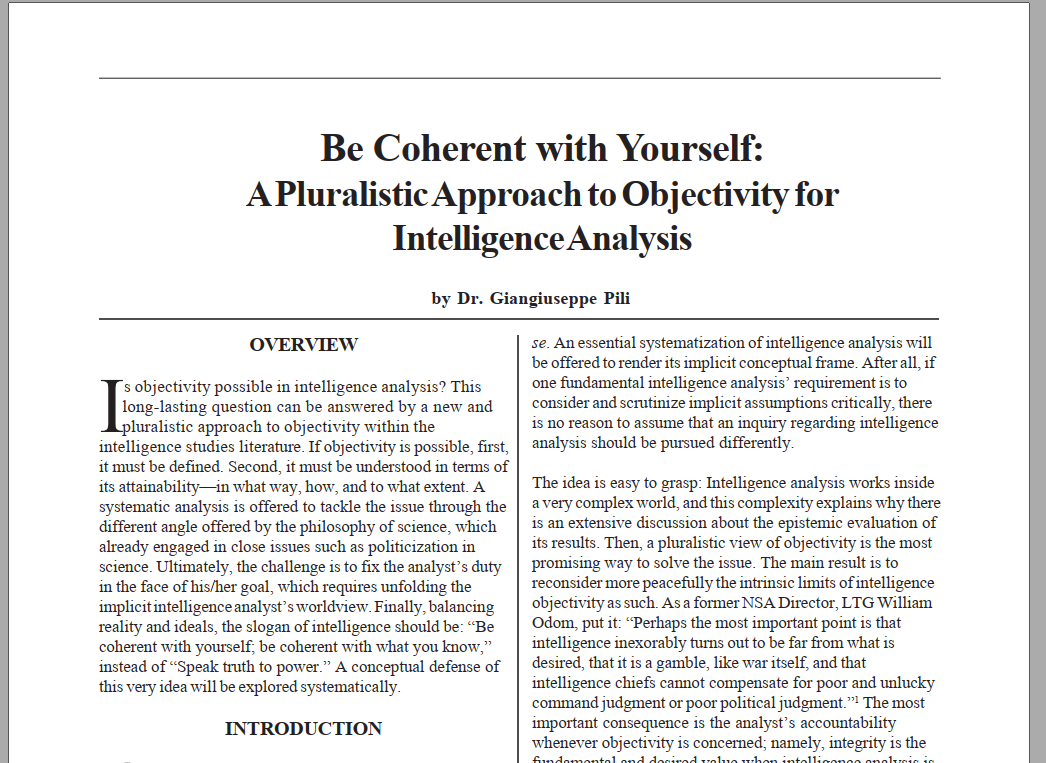
Pili, G., (2021), “Be coherent with yourself! A pluralistic approach to objectivity for intelligence analysis”, American Intelligence Journal, 38:1, 96-103.
Is objectivity possible in intelligence analysis? This long-lasting question can be answered by a new and pluralistic approach to objectivity within the s objectivity possible in intelligence analysis? This intelligence studies literature. If objectivity is possible, first, it must be defined. Second, it must be understood in terms of its attainability—in what way, how, and to what extent. A systematic analysis is offered to tackle the issue through the different angle offered by the philosophy of science, which already engaged in close issues such as politicization in science. Ultimately, the challenge is to fix the analyst’s duty in the face of his/her goal, which requires unfolding the implicit intelligence analyst’s worldview. Finally, balancing reality and ideals, the slogan of intelligence should be: “Be coherent with yourself; be coherent with what you know,” instead of “Speak truth to power.” A conceptual defense of this very idea will be explored systematically. Interested? Write me at scuolafilosofica_AT_gmail.com!
Di recente, parlando con il Master Chief di ScuolaFilosofica.it, Giangiuseppe Pili, è emerso che nel sito scarseggiano recensioni di libri scritti da russi. Indagando su questa curiosità, la conversazione si è defilata facilmente sulle idee personali circa la caratura delle varie letterature continentali, e da ambe le parti, ogni tanto, son partite scorribande di convinzioni individuali volte ad arrembare la solida nave delle convinzioni dell’altro.
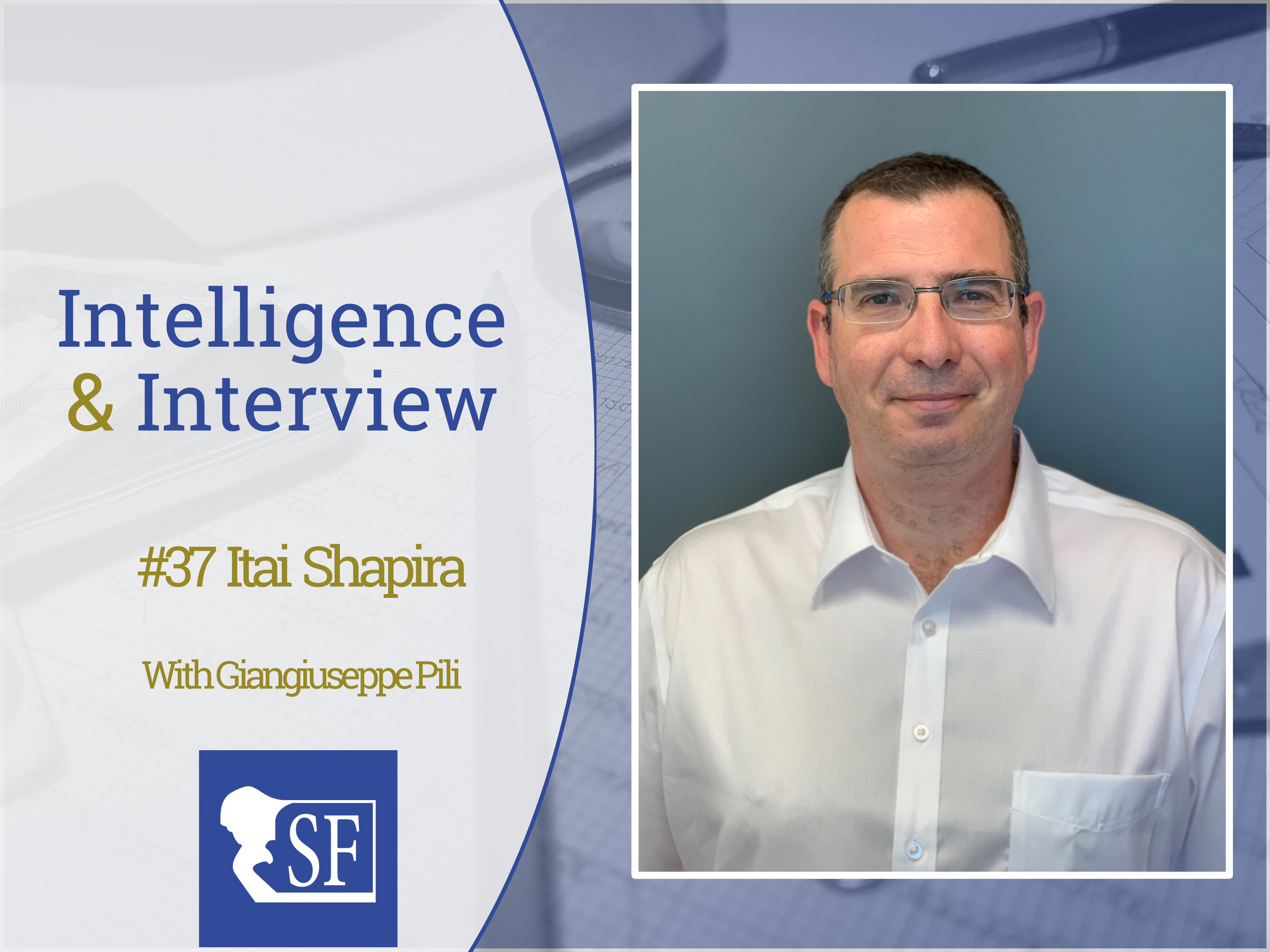
The very notion of intelligence is nuanced and broad. An entire branch of intelligence studies is devolved to exploring what intelligence is. This is what Mark Phythian and Peter Gill called “definitional project” in their taxonomy. Several scholars tackled the definition of intelligence, starting with Michael Warner’s pioneering paper Wanted: A definition of intelligence published in 2002 (almost achieving the twenty years anniversary). After him, many more tackled it (be kind if I advertise that I also proposed a philosophical definition of intelligence in 2019). But another crucial topic is the exploration of intelligence analysis functions such as strategic intelligence and tactical intelligence. Interestingly, strategic intelligence is still a difficult nut to be cracked. Probably because of its dependency on theory. Basically, strategic intelligence allows the identification of the enemy’s intentions to avoid surprises at the strategic level. Easy to say, but very difficult to achieve. Indeed, at least in the public debate, there is a sense that the Cold War was a predictable confrontation from a strategic perspective. Unfortunately, strategic intelligence was pursued with risk and uncertainty as everything else in intelligence. Although it is so important, it is still an underexplored topic. When I first read Itai Shapira’s paper, published by Intelligence and National Security (2019, Strategic Intelligence as an Art and a Science), I hoped we could have covered this topic, and now I am even more persuaded of this choice. Sure, the fact that he tackles the issue from theoretical and philosophical perspectives allured me even more. But, as you will see, there is a good reason for tackling strategic intelligence from this angle. Itai helps us understand the nature of strategic intelligence and tactical intelligence with a very innovative (fresh, I would venture to say) approach. It is then with my distinct pleasure to publish the interview on Scuola Filosofica – for those who don’t know it yet; it is one of the leading cultural blogs in Italy. In the name of Scuola Filosofica Team, our readers, and myself, Giangiuseppe Pili, Itai: thank you!
1# Itai Shapira, let’s start from the basics. How would you like to present yourself to the International readers and Philosophical School (Scuola Filosofica)?
I am currently a PhD candidate at the University of Leicester, studying Israeli national intelligence culture. I am a retired Colonel from the Israeli Defense Intelligence (IDI), where I have served for more than 25 years in various intelligence analysis and management roles – on the tactical, operational, and strategic levels. As a great believer in the dialectic of practice and theory, and after such a long period in the practice of intelligence, I am devoting the current period to a more theoretical perspective, trying to develop some theoretical concepts which in turn could influence practice.
Per Barthes, la dimensione del linguaggio (necessariamente codificato sia dalla sintassi sia dalla grammatica) non sosterrebbe mai i sensi d’una qualsivoglia parola. Fra il primo e la seconda, mancherebbe una separazione. Più semplicemente, succede che il linguaggio sia la singola parola. La filosofia di Barthes rientra nel tradizionale strutturalismo. Il senso d’una qualsivoglia parola comunque non sarebbe “nulla”, senza la simultaneità del suo codificarsi, grazie al linguaggio. La grafia testuale oppure la sonorità della voce precisamente si strutturano. Esse non si sostengono sul senso delle parole, perché lo determinano.
Però il linguaggio poetico è diverso, parendo strutturato al rinviare oltre se stesso. Là, tutte le parole hanno un senso “sorretto”. C’è la strutturazione della grammatica e della sintassi, ma verso la propria ristrutturazione d’un simbolismo. Per Barthes, la moda vanterebbe quasi una linguistica “poetica”. Ad esempio, la maglia sarà universalmente “codificata” per “riscaldare” il corpo. Però, quella finisce per diventare “liricamente” mitologica (idealizzandosi). La maglia presto si percepirà in tutto il “calore” della “comodità (praticità) esistenziale”. L’origine strutturalistica della moda col tempo tenderebbe simbolicamente al mitologico. I vestiti quindi si supportano, come accade per le parole poetiche. Sembra che quelli “atrofizzino” idealisticamente il mero funzionalismo alla loro origine. Certo ogni lirismo dovrà “cedere il passo” allo strutturalismo.
Sinclair, D., (2019), Lifespan, London: Harper Collins
Longevità è un saggio introduttivo ai principi chimico-biologici della durata nell’esistenza, per dirla filosoficamente. Sinclair si prefigge come obiettivo quello di spiegare le ultime ricerche sulla longevità (ovvero, sulla prolungazione della vita indefinitamente). Egli enuncia cause ed effetti di quella che lui ha chiamato “teoria informazionale della longevità”. Inoltre, Sinclair cerca di trarre utili conseguenze dai dati ricavati per avere immediatamente un impatto sulla propria (e altrui) qualità e quantità della vita. Probabilmente futuro premio Nobel, Sinclair delinea le principali tesi che possono riassumersi in poco, ovvero nello spazio di questa recensione.
Prima di tutto le cause. La vecchiaia, secondo Sinclair, dovrebbe essere equiparabile ad una malattia. Non esiste un limite fissato ex ante per la morte, o la vecchiaia stessa. Per quanto ne sappiamo sulla codifica del genoma umano, non esiste una combinazione meccanica di geni che porti alla morte. La vecchiaia, secondo Sinclair, è causata essenzialmente dalla moltiplicazione di errori nella codifica del DNA, e altri processi cellulari, a seguito di cause esterne.
Pili, G. (2021). “Why HAL 9000 is not the future of intelligence analysis: Intelligence analysis in the 21st century.” The Journal of Intelligence, Conflict, and Warfare, 4(1), 40–60. https://doi.org/10.21810/jicw.v4i1.2566
Abstract
Intelligence analysis is a core function of the intelligence process, and its goal is to synthesize reliable information to assist decision-makers to take a course of action toward an uncertain future. There is no escape from uncertainty, friction, and the fog of war. Since the dawn of human history, the present moment has been experienced as unpredictable, and the challenge of determining the right future through sound decisions has always existed. Investing in new technology, continually touted as the answer for analytic troubles, seems far less difficult in the short run than trying to find consensus about a long-term vision. It is easier to develop a nuclear missile, for example, than to give a universal definition of peace, and this is what the history of the XX century was all about. While intelligence analysis is still a necessary tool for decision-makers, it is unclear who or what will perform this function in the future. Though the solution cannot be only technological, the current trajectory tells a different story whereby the human analysts are removed from their central position to make way for Artificial Intelligence.
After so many topics, it was time to face one of the structured analytic techniques, also known by the acronym “SATs” (where the “s” is the plural). Actually, when I try to explain to my mother (ah, the mothers!) what intelligence analysis is about, I use SATs. Well, not for analyzing her, but for giving her a concrete example of what intelligence analysts do. All we need is SATs, according to many. But the research in the intelligence studies shows that SATs are not so widespread, their benefits are not so measurable, and ultimately (you will discover in this interview) they are not even so widespread. All the leading intelligence scholars from different corners of the world tackled the issue and, still, there is no universal agreement. Whatever their pros and cons, whatever they are, this is a crucial topic and, I believe, we all must know what they are (if we deal with intelligence). Exactly, for this reason, I thought it appropriate to let Alexei Kuvshinnikov speak about them. Indeed, Alexei is a passionate and professional SATs user, a member of the International Association for Intelligence Education (IAFIE), and, as you will discover, a promoter of SATs use. As a professional expert active in criminal investigation and narcotics for international institutions, and a teacher, he argues for the need for SATs for limiting biases and cognitive pitfalls. Considering his long experience in the field and his knowledge of intelligence methods, Alexei was an ideal referent for talking about this interesting topic. I don’t want to spoiler more, but if you are interested in intelligence analysis, this is something for you. It is then with my distinct pleasure to publish the interview on Scuola Filosofica – for those who don’t know it yet; it is one of the leading cultural blogs in Italy. In the name of Scuola Filosofica Team, our readers, and myself, Giangiuseppe Pili, Alexei: thank you!
1# Professor Alexei Kuvshinnikov, let’s start with the basics. How would you like to present yourself to the national and international readers and Philosophical School (Scuola Filosofica)?
Dear Giangiuseppe, thank you very much for the compliment, but I have to decline it. Being just a titleless lecturer with no academic qualifications beyond a Master´s degree, I have no pretence of belonging to the academia. Getting a taste of reality leads to getting a taste for reality, and graduate students can only benefit from it, that´s my firm belief. Accordingly, I teach SATs not as a science but rather as a tradecraft. You see, from an academic perspective, there is no difference between the academia and the real world. From the perspective of real-world operators, there often is.