
Per la Biennale di Venezia 2026, fino al 22 Novembre sono visitabili al Palazzo Mora le installazioni e le sculture di Carrie Able, durante la mostra in collettiva Personal Structures. Bisogna ricordare che lei fa anche la musicista. Esteticamente c’entra l’intersezione fra la tradizione delle belle arti e le tecnologie immersive dalla realtà estesa. Ma quanto dialetticamente ogni illuminazione si renderà addensante? E’ la fenomenologia già di Platone per il ricettacolo d’una materia appena informe, che il Demiurgo divinamente rimodellerà per un nuovo mondo. Al di là del surrealismo dentro la mitologia, l’astrazione al simbolismo della luce per Carrie Able non solo svelerà, ma anche genererà. Data la trasmissione del tempo, forse varrà la corrispondenza fra il limite iniziale del Big Bang ed il limite terminale d’un multiverso. La sonorità diventa importante, poiché essa è percepibile direttamente dall’udito (senza un “filtro regolante”, come per gli altri sensi). Carrie Able apprezza la sinestesia. Col multiverso, si vagheggia un’interazione fra persone in una realtà virtuale.
Carrie Able cerca una sinestesia per dipingere con la luce, ascoltando l’anima. Direttamente per sincerità, bisogna varcare i “padiglioni” del cuore… Carrie Able suggerisce al visitatore di scansionare le opere col proprio smartphone: forse in futuro la tradizionale radiografia, per saggiare l’autenticità d’un autore, evolverà nella “contaminazione” telematica da open source? Il vero artista è irripetibile perché fa il “precursore”, rispetto ad un “pacchetto” di novità, stilisticamente. Carrie Able scolpisce partendo dalla traccia che le ha fornito un visore. Possiamo chiederci quanto un pittore s’accorga delle linee pennellate, complici le velature. Per il metaverso, le credenziali d’accesso non serviranno a proteggere la “curiosità” d’una singola persona, bensì a pianificare una rete di condivisione sociale. La fisica tratta le onde gravitazionali. Per viaggiare in quelle, servirà la pianificazione d’un tappeto volante, al surrealismo. Senza coprirsi separatamente, ci si annoderà, sviluppando l’appiglio, ad una rete sospesa nel vuoto. Limitatamente alla nostra Terra, Carrie Able avrà aggiunto un radar, grazie al visitatore, sulla pennellata pittorica: per girare intorno con la tridimensionalità, esattamente perché ciò vale nella vitalità, rispetto ad una situazione. Si respinge la tecnologia asettica. Un visore perfino “eternizza” l’accomodamento dei meri occhiali ad un campo. Si tratta di concentrare per “rimpallo” emotivo l’indifferenza stabilizzante d’una contemplazione. Qui si nasconderà la chiave per far “ingelosire” al radicalismo la “promiscuità” d’una serialità condivisa. L’inventore si promuove marcando una differenza dalla normalità. Il prodotto di massa concentra in sé una storia di necessità da accomodare, e modernamente tiene una rete d’applicazioni che gli permettono di “calzare a pennello”, in base ai gusti personali. Questa ci pare la dialettica per l’artista nel metaverso.
Karl Marx si convinse che il capitalismo borghese sarebbe necessariamente crollato dopo la ribellione del proletariato. Un intero popolo avrebbe infine raggiunto la felicità, senza nemmeno ordinarsi mediante lo Stato. Per Maurizio Ferraris, uno sviluppo dell’Intelligenza Artificiale impedirà quantomeno l’alienazione a lavoro. Alla tastiera del computer, le braccia certamente non faticano. L’Intelligenza Artificiale potrebbe lasciare i lavoratori a rilassarsi, perfino eliminando le classi sociali (come avrebbe gradito il marxismo). E’ un augurio che però rischia di realizzarsi per distopia, eticamente. Pochi gruppi di potere proverebbero ad emergere a discapito delle masse, manovrandole sul vissuto sia privato sia pubblico, partendo da una competenza tecnologica.
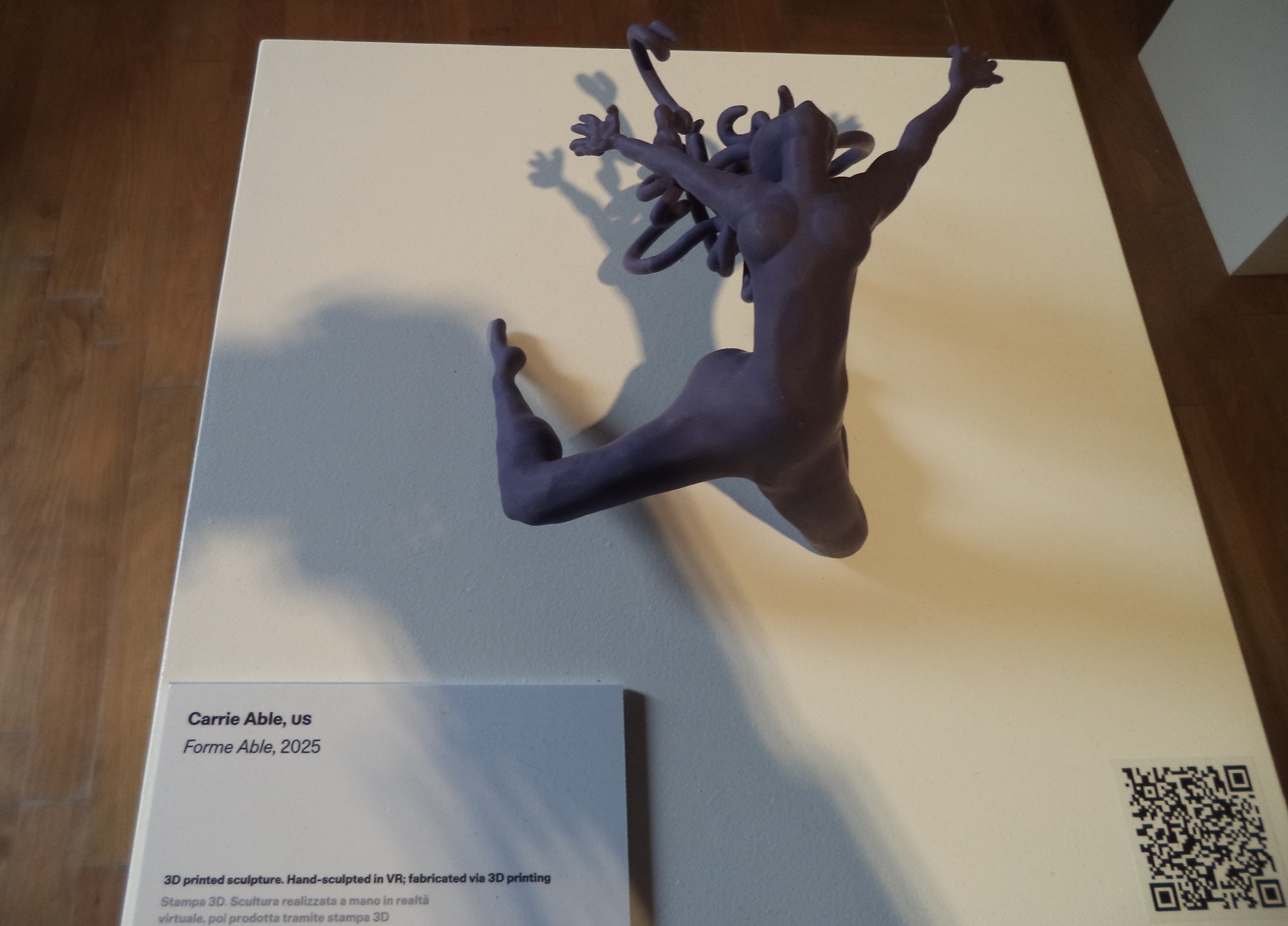
C’è una scultura dove la figura femminile ha una sorta di criniera a ganci. Al decorativismo per i ricci si potrà aggiungere un funzionalismo da gadget. Le onde elettromagnetiche si percepirebbero al vitalismo se fossero placentari. Il corpo posa in una catapulta per la contemplazione, dall’estasi alla trasfigurazione. In Terra, immagineremmo la spinta dal grembo, per il nascituro. Alla trasfigurazione ci sarà un allacciamento con le spire delle stelle infuocate, sulle onde galattiche. La tonalità al grigio-viola si percepisce illuminando un fondale marino, affinché riaffiori la criniera placentare nella barriera corallina, dove sopravvive almeno la bellezza.
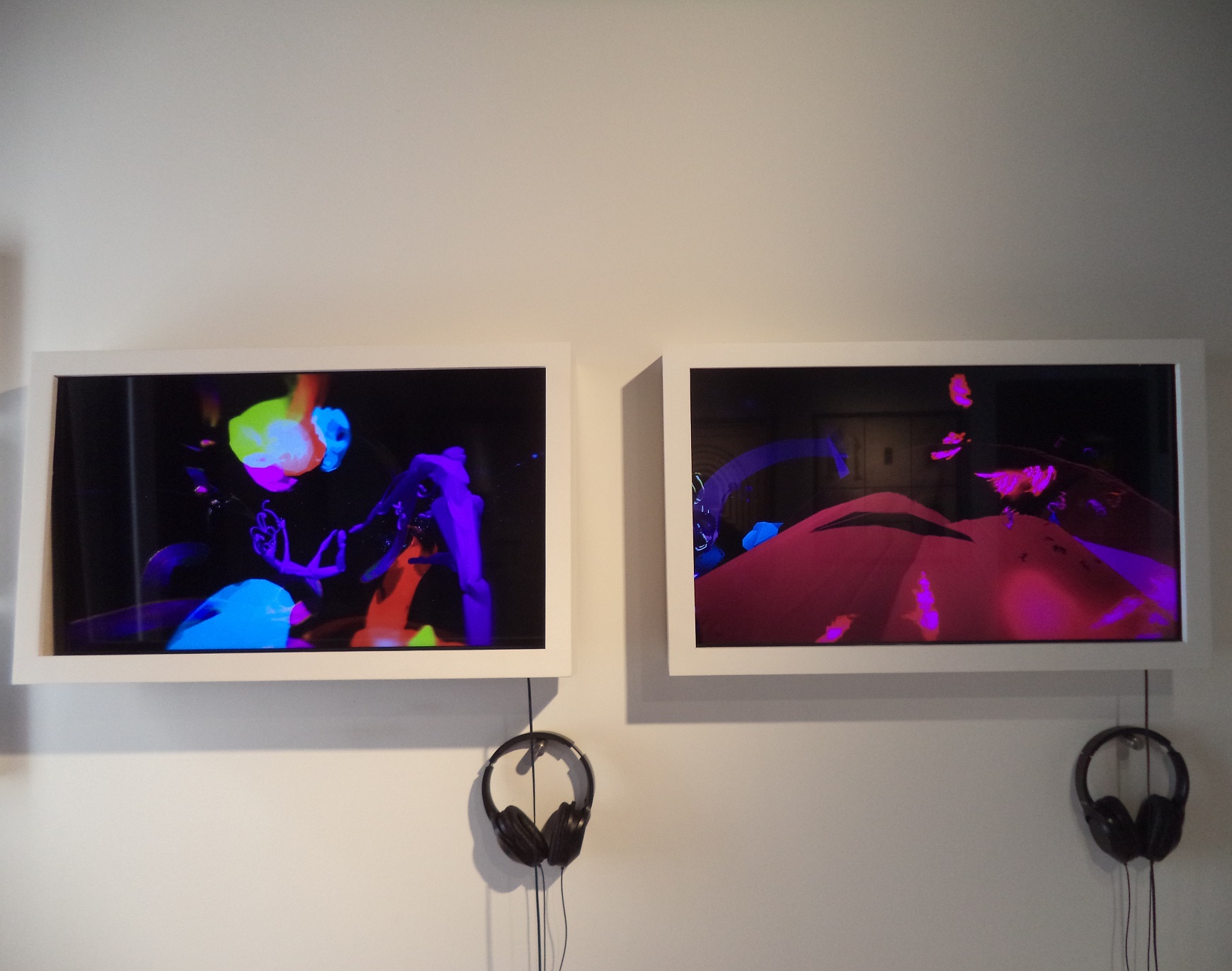
Dalla videoinstallazione, l’astrazione dei poliedri s’umanizzerebbe mediante una tensostruttura di respiro per la muscolatura. Un ventaglio cavalcherà sul punto di fuga che accentra, contro le rampe della striatura. La vampata si percepirà lubrificante, rispetto alla gelatina. Senza il manichino modernamente robotizzato di Giorgio De Chirico, in una metafisica del surrealismo servirà un feto per l’ombra. Esiste la stilizzazione del prisma ottico, col vitalismo che per Carrie Able si percepirebbe dai raggi infrarossi od ultravioletti.
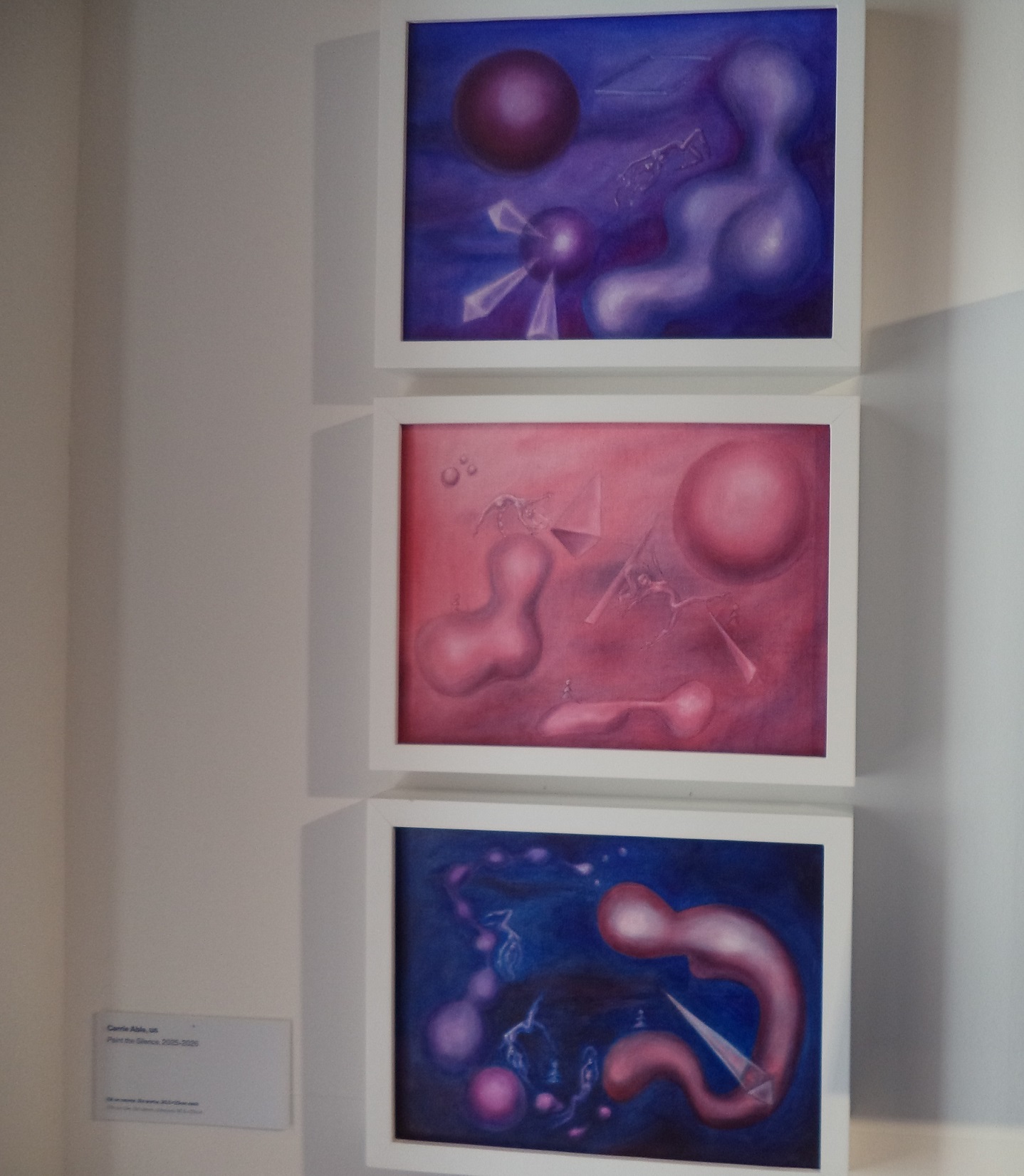
I pianeti si collegherebbero grazie ad una catenina, con l’argento dell’atmosfera ad influenzare il plasma del sangue (dove i globuli rossi traboccano per emotività). Più genericamente, le figure di Carrie Able ci ricordano quelle di Joan Mirò, al surrealismo. Magari i coriandoli carnevaleschi si ricompatteranno nella propria espansione, come per il Big Bang. Ma potremo immaginare una sirena per lo spettro? L’Arlecchino sarà mosso dalla “marionetta” del visore. Carrie Able privilegerebbe le tonalità “primordiali” del rosa e dell’azzurro: rispettivamente per le femmine ed i maschi, dal simbolismo. In un “cuore” del multiverso, i pianeti avrebbero una pulsazione atta perfino a farli rotolare. L’astrazione dei poliedri sarebbe tirata dal “marionettista” della retina, coi coni ed i bastoncelli ad appigli sulla gelatina del corpo vitreo. Perdendosi nell’Universo, per allievare la solitudine servirebbe almeno l’abbraccio con un intero pianeta. Si toglierà qualunque paura di cedere per “insabbiamento” ad una galassia. Probabilmente, in un multiverso le risapute leggi della Gestalt sulla percezione si puntellerebbero per coralità. Servirà perlustrare per capire di che pasta si è fatti, rispetto alle diverse situazioni.
THE ILLUMINATION WHICH MAKES ITSELF THICKENING IN A HEART OF THE MULTIVERSE
For the Venice Biennale 2026, until 22 November we can visit at the Palazzo Mora the installations and the sculptures of Carrie Able, during the collective exhibition Personal Structures. We have to remember that she is also a musician. Aesthetically an intersection between the tradition of the fine arts and the immersive technologies of the extended reality is significant. But how much dialectically will every illumination make itself thickening? This is the phenomenology already in Plato for a receptacle of a matter only shapeless, which the Demiurge divinely will remodel for a new world. Beyond the surrealism inside the mythology, the abstraction at the symbolism of the light according to Carrie Able not only will unveil, but also will generate. Considered the transmission of the time, perhaps a correspondence between the initial limit of the Big Bang and the final limit of a multiverse will be valid. The sonority becomes important, because it can be perceived directly from the hearing (without a “regulatory filter”, like for the other senses). Carrie Able appreciates the synaesthesia. With a multiverse, we yearn for an interaction between people in virtual reality.
Carrie Able looks for a synaesthesia to paint with the light, listening the soul. Directly for a sincerity, we have to cross the “auricles” of the heart… Carrie Able suggests that the visitor scans the works by the own smartphone: perhaps in the future the traditional radiography, to probe the authenticity of an author, will evolve in a telematic “contamination” from an open source? The real artist is unrepeatable because he is a “precursor”, compared to a “package” of innovations, stylistically. Carrie Able sculpts starting from a track that a headset provided for her. We can ask how much a painter realizes the lines from the brush, with the complicity of the veining. For a metaverse, the login credentials will not need to protect the “curiosity” of a single man, but they will serve to plan a net of social sharing. The physics concerns the gravitational waves. To travel in those, we will need to plan on a flying carpet, at the surrealism. Without covering ourselves separately, we will knot ourselves, developing the handhold, with a net suspended in the void. Considering only our Earth, Carrie Able will add a radar, through the visitor, on the brush stroke to paint: to turn around in it with the three-dimensionality, exactly because this is valid in the vitality, compared to a situation. An aseptic technology is rejected. The headset even “eternizes” the arrangement of the mere glasses on a field. This happens with a concentration for an emotional “rebound” about the indifference, which stabilizes, of a contemplation. Here the key, allowing at the radicalism to instill “jealousy” in the “promiscuity” of a shared seriality, would be hidden. An inventor promotes himself marking a difference from the normality. The mass product concentrates on itself a history of necessities for their arrangement, and in a modern way it keeps a net of applications that allows it to “fit like a glove”, according to the personal tastes. That seems to us the dialectics for an artist in a metaverse.
Karl Marx was convinced that the bourgeois capitalism would have been collapsed after a rebellion of the proletariat. An entire population finally would have reached the happiness, without even being ordered through a State. According to Maurizio Ferraris, a development of the Artificial Intelligence will at least impede an alienation at work. At the keyboard of the computer, the arms surely don’t toil. The Artificial Intelligence could leave the workers to relax, even eliminating the social classes (as the marxism would have appreciated). This is a wish which however is in danger of being realized for a dystopia, ethically. Small groups of power would try to emerge to the detriment of the masses, maneuvering those in the living both private and public, starting from a technological competence.
There is a sculpture where a female figure has a sort of mane with hooks. A functionalism for the gadget could be added to the decorativism for the curls. The electromagnetic waves would be perceived at the vitalism if these were placental. The body poses in a catapult for the contemplation, from the ecstasy to the transfiguration. On Earth, we will imagine the push of the womb, for the baby. At the transfiguration, a connection with the coils of the inflamed stars, on the galactic waves, will happen. The tone of the grey-violet is perceived illuminating a seabed, in order that a placental mane in the barrier reef reemerges, where at least the beauty survives.
From the video installation, the abstraction of the polyhedrons would be humanized through a tensile structure which breathes for the musculature. A fan will ride on the vanishing point that centralizes, against the ramps of the striation. The burst of flame will be perceived lubricating, compared to the gelatin. Without the dummy in a modern way robotized of Giorgio De Chirico, in the metaphysics for the surrealism a foetus for the shadow will be necessary. The stylization of the optical prism exists, with the vitalism that according to Carrie Able would be perceived from the infrared or from the ultraviolet rays.
The planets would be connected through a chain, with the silver of the atmosphere to influence the plasma of the blood (where the red cells overflow for an emotionalism). More generically, the figures of Carrie Able remind us the figures of Joan Mirò, at the surrealism. Maybe the carnivalesque confetti will be more compact in the own expansion, like for the Big Bang. But could we imagine a mermaid for the spectrum? Harlequin will be moved by a “marionette” of a headset. Carrie Able would privilege the “primordial” tones of the pink and of the blue: respectively for the females and for the males, from the symbolism. In a “heart” of the multiverse, the planets would have a pulsation suitable even for their rolling. The abstraction of the polyhedrons would be pulled by a “puppeteer” of the retina, with the cones and the rods as handholds on a gelatin of the vitreous body. Lost in the Universe, to alleviate the loneliness we would need at least an embrace with the entire planet. We will remove whatever fear of ceding to a galaxy for an “cover-up”. Probably, in the multiverse the well known Gestalt principles about the perception would be shored up for a choral action. To discover what we are made of, compared to the different situations, we will need a patrol.

Paolo Meneghetti

Be First to Comment