
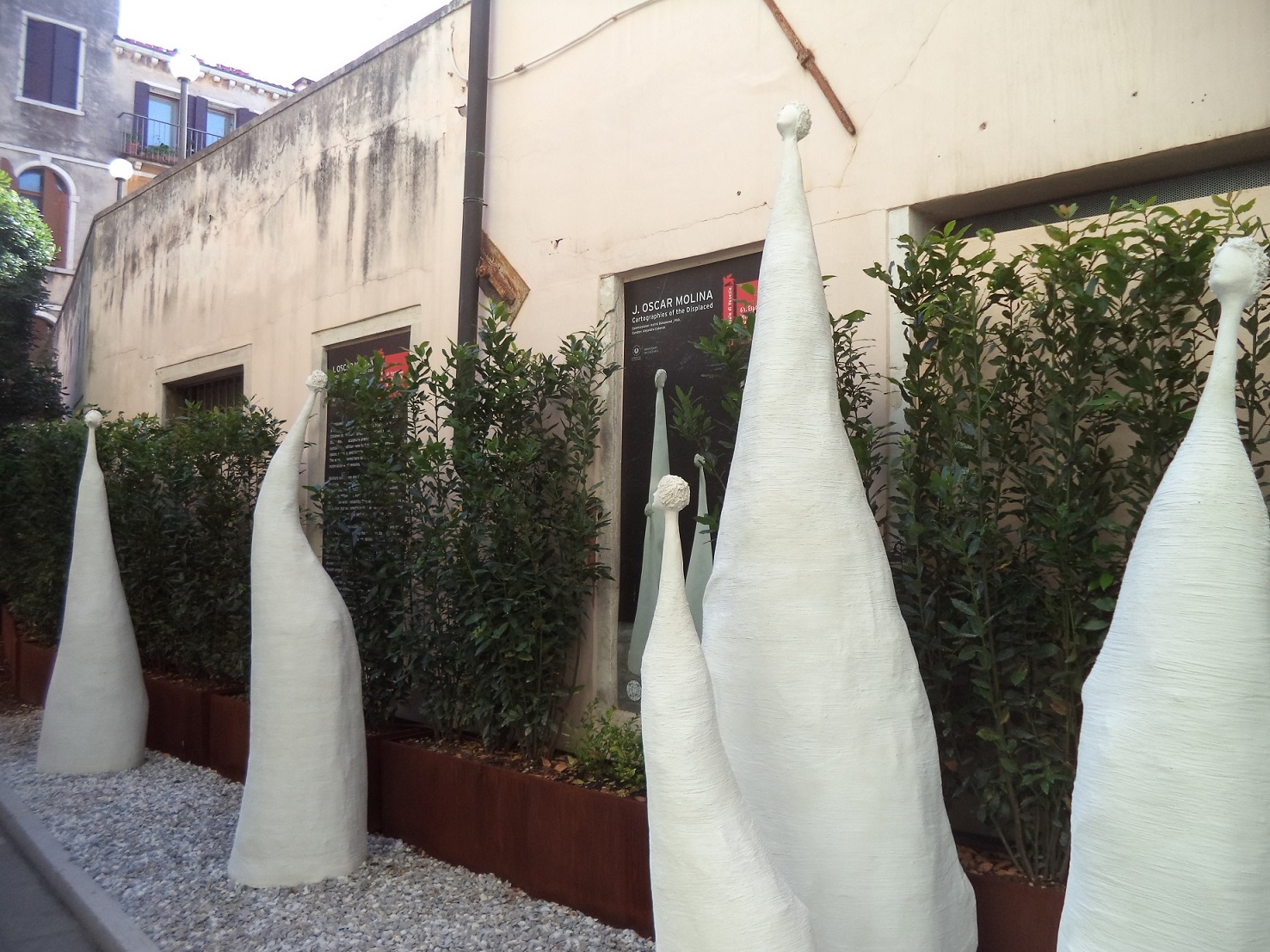
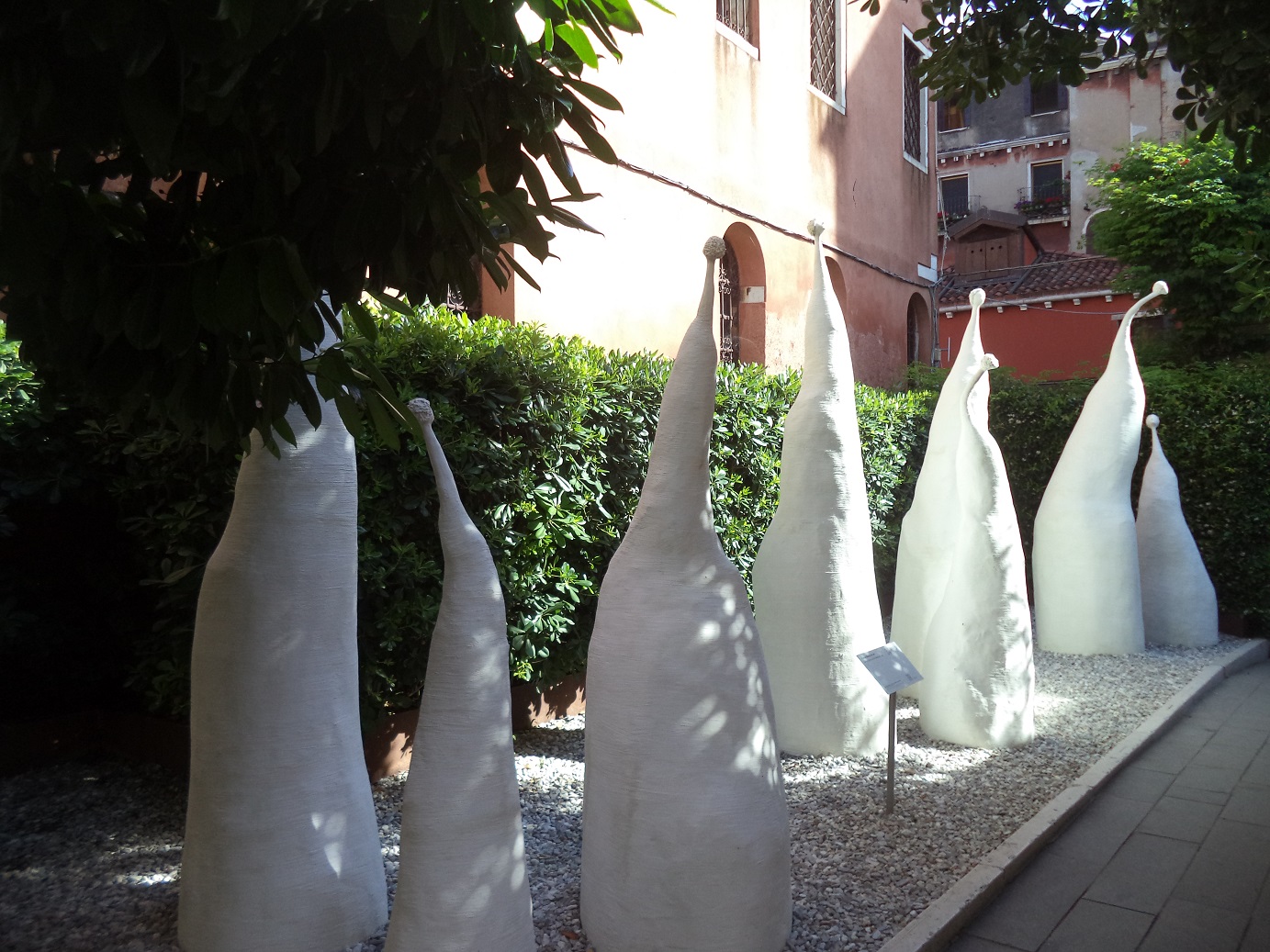
A Venezia, per la Biennale d’Arte 2026, è visitabile il Padiglione Nazionale di El Salvador, avente le sculture di José Oscar Molina, e presso il Palazzo Mora. Esteticamente, gli interessa uno snodo per la mente oltre ogni tensione del corpo. La mostra, che s’intitola Cartographies of the displaced, è stata curata da Alejandra Cabezas. La società contemporanea si trasforma grazie alle migrazioni. Questo comporta una dissoluzione dei confini politici. El Salvador rientra in un corridoio geografico, fra le due Americhe. L’uomo odierno appare costantemente “sradicato” all’incertezza degli spostamenti. C’è lo stress per quei progetti di vita che faticano a realizzarsi. Allora si reagirà per flessibilità, con la riqualificazione dell’ambizione? Le sculture di Molina hanno teste che “spuntano come spore di funghi”, in cima a colonne di “bruchi per stalagmiti”. E’ arduo mappare una grotta: più diramazioni potrebbero restringersi. La farfalla libra casualmente, senza avere una meta fissa. In una grotta, il campo elettromagnetico per la telefonia salta: le antenne si faranno “sballottare”, fra le rocce. La stalagmite è di snodo per il ristagno. La preoccupazione per il disorientamento si previene dal filo di Arianna: e non solo mitologicamente! Ma quanto al “bruco” sarà concesso di potersi rifare una vita, in un simbolismo per la politica?
Le sculture di Molina si percepirebbero mediante i fusi (menzionando una tradizione che risale al Neolitico, in America del Sud). Nella società contemporanea, noi rischiamo che a “spuntare come i funghi” siano le “cariatidi”, anziché le “condutture”. Da un conformismo non sorgerà l’innovazione. Le sliding doors sui progetti da riqualificare avrebbero le guaine simbolicamente “con le spore”. Se le ambizioni svaniscono (classicamente giacché esistono gli “antagonisti”), allora bisogna evitare di sobbarcarsene le ombre, rimuginando. Politicamente, i meri speculatori “sguazzano”: ad esempio provando a contestare l’ineluttabilità dell’immigrazione, mappata a mezzo ghettizzazione. Ma così s’impedisce ogni evoluzione per la flessibilità. Molina ha installato dei coni, la cui testa si percepirà al “faro prospettico”. Non serve a nulla mappare, o peggio schedare. La storia in senso lato ha i suoi corsi e ricorsi, sui quali noi dovremo pure aggiornarci, per progredire. Un bravo politico li governerà mediante la lungimiranza, senza temere uno spaesamento iniziale. In parecchi Paesi dell’Occidente l’immigrazione può compensare la denatalità. Per Molina conta poco da dove si viene, rispetto a chi si vuole diventare. Dall’immigrazione, la seconda generazione deve rimodellarsi per integrazione. La dialettica sarà tra la frammentazione e la resilienza. In una grotta, la stalagmite non si percepisce d’impaccio, poiché essa decanta la luce mancante, all’illusione di dissotterrare i metalli preziosi. La città contemporanea “pullula” di vitalità grazie ai quartieri popolari per multietnicità. L’underground anticipa gli stili del futuro, esteticamente.
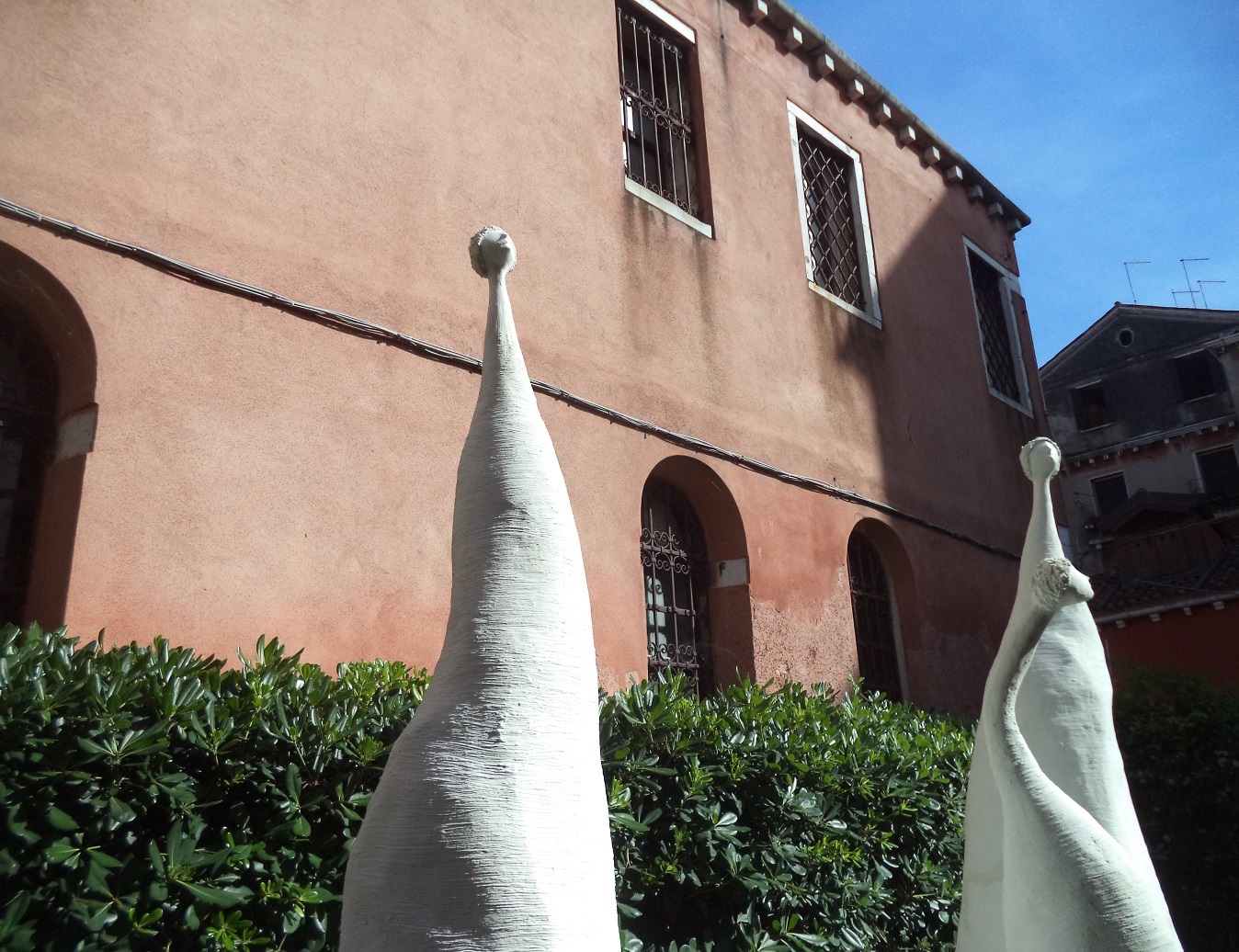
A Molina interesserebbe la liberazione dal nascondiglio. Gli emarginati, dalle minoranze, rischiano paradossalmente di colpevolizzarsi da soli: ad esempio per un pessimismo sulle proprie capacità di rivoluzione. Si conosce il fenomeno naturale che causa di frequente le piramidi di terra. Quelle di Molina avrebbero eroso l’impaccio per un condizionamento (culturale, familiare, psicologico ecc…), se la testa imparerà a vedere il mondo circostante da una prospettiva diversa. Sui progetti di vita, la maturità alla teoria “si sposa” con la sostenibilità alla prassi; il governo democratico permetterà che ciascuno “se la giochi” dalle stesse risorse di base. Soprattutto Molina “ipnotizzerebbe” le pressioni (caratteristiche dei nazionalismi). Perché un migrante dovrà giustificarsi, ad esempio sfuggendo da una guerra? Lo Stato garante della democrazia rimane quantomeno “disordinato” sul melting pot.
I “fortunati” cittadini dell’Occidente si preparano lo zaino dei sogni, dal mito del self-made man (sul quale il capitalismo specula, oltre il palliativo una tantum dal turismo di massa). Se le sculture di Molina rivisitassero i birilli al bowling, allora quelli si salverebbero dalla caduta lanciando dalla teste un gancio di sicurezza più che un grido d’aiuto. Comunque la levigazione “si sposa” con la melodia, alla sinestesia. Laicizzando la fede, dal capirote, occorre “metterci la faccia” per rivendicare il diritto all’autodeterminazione, innanzi alle ingiustizie materiali. Molina progetta un allestimento corale. L’unione fa la forza: soprattutto per gli emarginati. Nelle sculture, gli orizzonti si percepiscono fluidi rispetto alla “nave” che li dovrà affrontare: quantunque al cono d’ombra, ne emergerebbe il “rostro” ed evitando, positivamente, lo stallo esistenzialistico per il masso dal mito di Sisifo. Il sacco a pelo laicizza i desideri dalla lampada di Aladino, poiché il lusso più grande è il viaggio, paradossalmente accontentandosi di poco. I migranti, avendo perso tutto, non possono che ringraziare chi li accoglie. Il saccopelista s’addormenterebbe felice nel deserto, per contemplare spontaneamente la bellezza delle stelle, senza chiedere a quelle d’esaudire altri desideri. Molina sceglie d’allegare, a mezzo QR code, i racconti di persone purtroppo sfollate. E’ qualcosa di semplice ma intenso. Conta la voglia di sensibilizzare, socialmente. Coerentemente, il materiale adoperato per le sculture è comune ma fragile.
WHO KNOWS HOW MUCH WE ALLOW THE CATERPILLARS FOR THE STALAGMITES TO START A NEW LIFE
In Venice, for the Venice Biennale 2026, we can visit the National Pavilion of El Salvador, which has the sculptures of José Oscar Molina, and at the Palazzo Mora. Aesthetically, he is interested in a junction for the mind beyond every tension of the body. The exhibition, whose title is Cartographies of the displaced, was curated by Alejandra Cabezas. The contemporary society is transformed through the migrations. This entails a dissolution of the political borders. El Salvador reenters in a geographical corridor, between the two Americas. The current man appears constantly “uprooted” at the uncertainty of the movements. There is the stress for the typical projects that we struggle to realize. So will we react for a flexibility, with a redevelopment of the ambition? The sculptures of Molina have the heads that “sprout like spores of mushrooms”, on top of “caterpillars for the stalagmites”. It is difficult to map a cavern: more branches could shrink. A butterfly soars by chance, without having a fixed destination. In a cavern, the electromagnetic field for the telephony goes out: the antennae will suffer a buffeting, between the rocks. The stalagmite is a junction for the stagnation. A worry for a disorientation is prevented by the Ariadne’s thread: and not only mythologically! But how much we will allow the caterpillar to start a new life, in a symbolism for the politics?
The sculptures of Molina would be perceived through the spindles (mentioning a tradition which dates back to the Neolithic Age, in South America). In the contemporary society, we risk that the “old guards” as “caryatids”, instead of the pipes, “will sprout like mushrooms”. The innovation will not arise from a conformism. The sliding doors on the project that we have to redevelop would have the gaskets symbolically “with the spores”. If the ambitions disappear (classically because the opponents exist), so we will have to avoid to “bear the cost” of their shadows, overthinking. Politically, the mere speculators “are in their elements”: for example trying to criticize the ineluctability of the immigration, mapped through a ghettoization. But in this way every evolution for the flexibility is impeded. Molina installed some cones, whose head will be perceived in a “perspectival floodlight”. It is useless to map, or worse to catalogue. The history in a broad sense has the own occurrences and recurrences, on which we will also have to keep up-to-date, to progress. A good politician will govern those through a foresight, without being afraid of an initial disorientation. In many countries of the West the immigration can compensate for the declining birth rate. According to Molina, the < where you can from? > counts for little compared to the < who you want to become? >. From the immigration, the second generation has to remodel itself for an integration. The dialectics will be present between a fragmentation and a resilience. In a cavern, the stalagmite is not perceived as a hassle, because it decants the lacking light, in the illusion of a digging up of the precious metals. The contemporary city “throbs with vitality” through the popular neighborhoods for a multiethnicity. The underground foresees the styles of the future, aesthetically.
Molina would be interested in a liberation from a hiding place. The outcasts, from the minorities, risk paradoxically to blame themselves all alone: for example for a pessimism about the own ability to make a revolution. We know the natural phenomenon which often causes the earth pyramids. Those of Molina would have eroded the hassle for a conditioning (cultural, family, psychological etc…), if the head will learn to see the surrounding world from a different perspective. On the life projects, the maturity at the theory “is combined with” the sustainability at the praxis; a democratic government will allow everybody “to play his cards” from the same basic resources. Principally Molina “would hypnotize” the pressures (typical of the nationalisms). Why should a migrant justify himself, for example escaping from a war? A State which guarantees the democracy remains at least “disorganized” about the melting pot.
The “lucky” citizens in the West prepare their backpack of the dreams, from the myth of the self-made man (on which the capitalism speculates, beyond the palliative one-time of the mass tourism). If the sculptures of Molina revisited the skittles at the bowling, so those would save themselves from the fall throwing from the heads a safety hook more than a cry for help. However the smoothing “is combined with” the melody, at the synaesthesia. Secularizing the faith, from a capirote, it is necessary that “we stand up and be counted” to claim the right to the self-determination, in front of the material injustices. Molina plans a choral staging. Unity is strength: principally for the outcasts. In the sculptures, the horizons are perceived as fluid compared to a “ship” that will have to face those: although in a shadow cone, their “rostrum” would emerge and avoiding, positively, an existentialist stalemate for the rock from the Myth of Sisyphus. A sleeping bag secularizes the desires from an Aladdin’s lamp, because the ultimate in luxury is the travel, paradoxically when we are satisfied with little. The migrants, after they lost everything, are almost forced to thank somebody who host them. A backpacker would happily fall asleep in the desert, to contemplate spontaneously the beauty of the stars, without asking them to fulfill other wishes. Molina chooses to attach, through a QR code, the stories of people unfortunately displaced. This is something simple but intense. The desire to attract the interest, socially, counts. Coherently, the material used for the sculptures is common but fragile.

Paolo Meneghetti

Be First to Comment