


Run out and find me a four-year-old child. I can’t make head or tail out of it. – Groucho Marx
Introduction to Emoji Logics and Caveats
For many years I studied formal logics and set theory alongside everything else. They were the intrinsic foundation of my background work, the one that never appeared on the surface because it was too personal and too specific at the same time.[1] Moreover, in spite of many applications of formal logic thinking from war to society, I never fully embraced the sheer love for machinery or formal symbolism because I am much more semantically driven.[2] In fact, I am obsessed by semantics and natural language and the more I think about them the deeper the obsession. Although I have been always skeptical on analytic philosophy implicitly share belief that it is all about bad use of unclarified language and truth-values, I am in fact as obsessed as the later Wittgenstein or Kant in the three major critiques, which are essentially a quest for understanding how our judgements (statements) is even possible. In fact, I even argued that the deconstruction of judgement through language was ultimately what Kant achieved in the Critique of Pure Reason.[3]
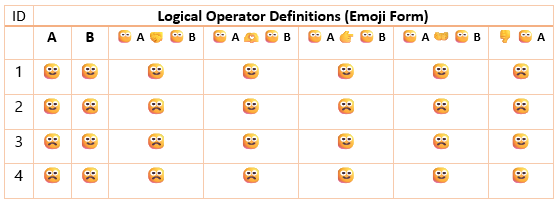
However, this does not change my sheer admiration for those pillars of thought who elaborated formal logics how we know it and Kurt Godel has been my logical hero since I started my logical quest twenty-four years ago.[4] As a result of my effort to teach formal and informal logics, I arrived to conceive an idea to how teach basic principles of formal logics to kids. I am not very versatile with very young kids, that is, less than 14 and I don’t have any evidence of specific applications of the system I am proposing here, but the idea is very simple. Formal logic is about creating a system of codified symbols to be manipulated syntactically, that is, through the ‘simple’ application of rules, we can be creative in selecting what symbols we want to use. What if we are creative and use emoticons for formalizing propositional logic?
With this intuition in mind, I propose the following formal logic game that could be used for teaching logic to kids. I welcome any reader to try and report what happened and how it worked in the comments section.