Press "Enter" to skip to content

Categoria: Filosofia del Linguaggio

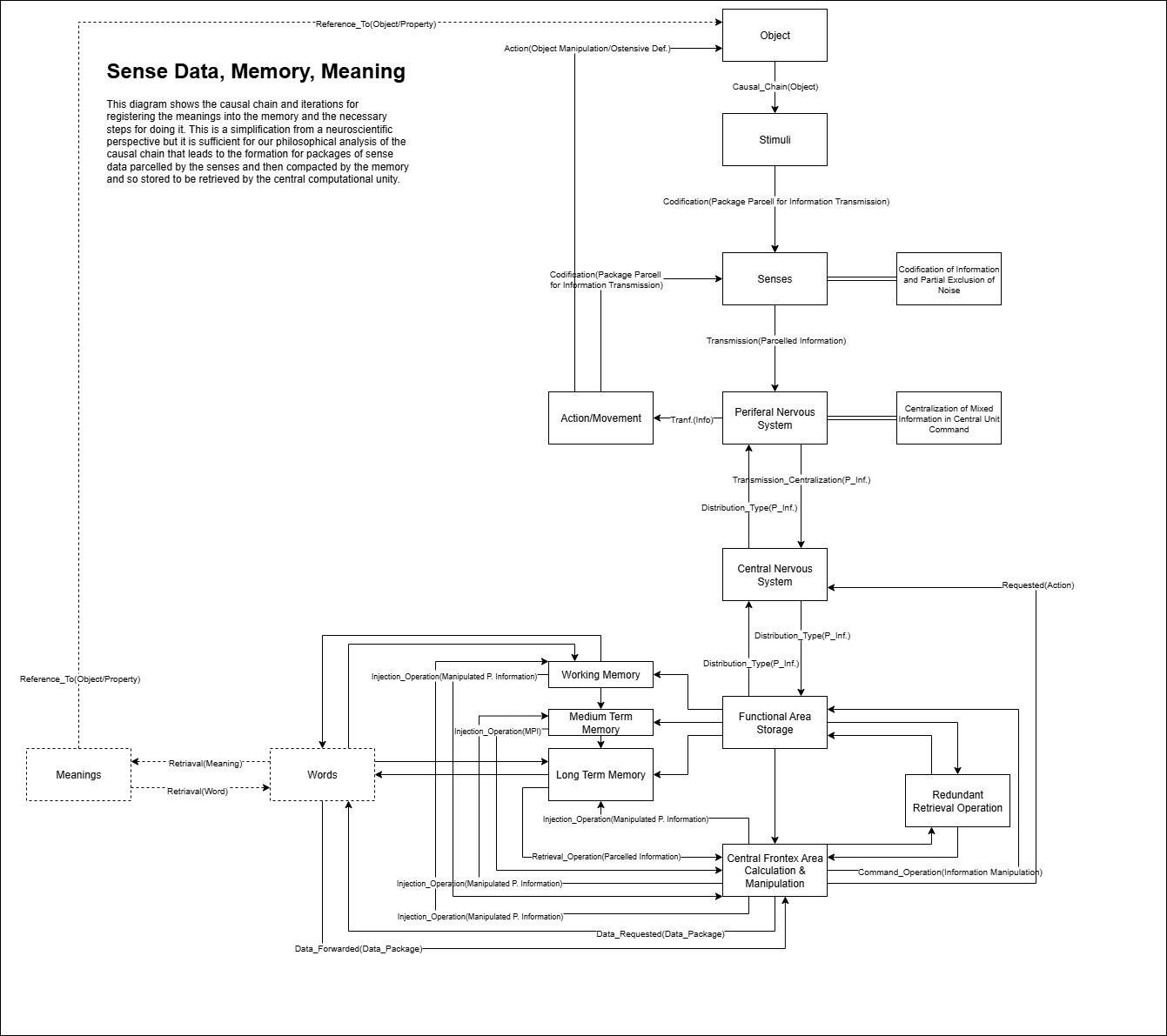
Memory, Meanings and Language – How We Think About Things

Memory – Copyrights Owned by the Author

How does language connect to the world? A simple, ancient question that should hunt every serious scholar in any field. For example, what do we mean when we say, ‘The army fought bravely against Nazi Germany’ or ‘All crows are black’? How can we connect an ‘army’ to ‘braveness’ and its ‘fighting’ ‘against Nazi Germany’? What do we actually mean by ‘all crows’? No matter how one wants to tackle the problem, this is quite an astonishing open-ended hurdle that every new generation of thinkers must recalibrate or reframe.[1]

Plato started the quest because of his idealist conceptualization of knowledge, which was understood only as perfect in terms of access to the ideas which, in turn, must refer to the world somehow. However, how to connect his ideas to a specific ‘table’ is not an easy endeavor and Aristotle tried to reverse the process: we describe ‘tables’ given the knowledge we get from every specific table. But then, how can we have a general notion of tables? From where this ‘generality’ comes from and how can it be justified? Ultimately, these answers can be partially given reformulating the problem in terms of meaning. The meaning of the sentence ‘the table is black’ depends on the meanings of its constituent components. What does meaning mean? We need to clarify what the meanings of words (in theory, all of them, including prepositions, indexicals, and prepositions).

Interestingly, so-called idealist philosophers such as Renè Descartes and Baruch Spinoza reinterpreted the idealist vision in subjective terms. Plato assumed that ideas are external non-causal entities existing outside the phenomenon and the mind. They stay there eternally unmoving mysteriously able to give us a real glimpse of a stable world. Firstly, Descartes reinterpreted this concept within the subject itself: ideas are stable construction of the cognitive subject whose access is granted by direct introspection whose strength is supplemented by reason. However, the grasp of concepts can be independent from reason, which has the primary goal to make arguments based on those ideas and concepts. Of course, Descartes had the same problem Plato had; that is, how to connect ideas to the world. In his case, he had to make a brilliant and convoluted argument based on the alignment between ideas and the world granted by God and by the general architecture of cognition.[2] Spinoza, partially endorsing and criticizing Descartes, extended those lines of arguments: not only ideas can be explicitly grasped directly through a special direct introspection (intuition) but reason is the sole means to grant justification in elaborating new ideas.[3]

Emojis Logics – How to Explain Logical Thinking to a Four-Year Old

Emoji Logic, Author

Run out and find me a four-year-old child. I can’t make head or tail out of it. – Groucho Marx


Introduction to Emoji Logics and Caveats

For many years I studied formal logics and set theory alongside everything else. They were the intrinsic foundation of my background work, the one that never appeared on the surface because it was too personal and too specific at the same time.[1] Moreover, in spite of many applications of formal logic thinking from war to society, I never fully embraced the sheer love for machinery or formal symbolism because I am much more semantically driven.[2] In fact, I am obsessed by semantics and natural language and the more I think about them the deeper the obsession. Although I have been always skeptical on analytic philosophy implicitly share belief that it is all about bad use of unclarified language and truth-values, I am in fact as obsessed as the later Wittgenstein or Kant in the three major critiques, which are essentially a quest for understanding how our judgements (statements) is even possible. In fact, I even argued that the deconstruction of judgement through language was ultimately what Kant achieved in the Critique of Pure Reason.[3]

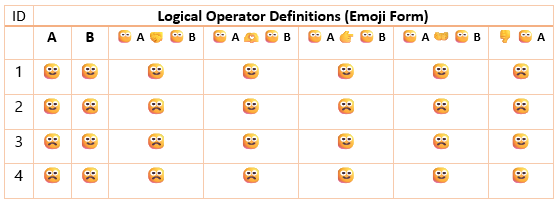
However, this does not change my sheer admiration for those pillars of thought who elaborated formal logics how we know it and Kurt Godel has been my logical hero since I started my logical quest twenty-four years ago.[4] As a result of my effort to teach formal and informal logics, I arrived to conceive an idea to how teach basic principles of formal logics to kids. I am not very versatile with very young kids, that is, less than 14 and I don’t have any evidence of specific applications of the system I am proposing here, but the idea is very simple. Formal logic is about creating a system of codified symbols to be manipulated syntactically, that is, through the ‘simple’ application of rules, we can be creative in selecting what symbols we want to use. What if we are creative and use emoticons for formalizing propositional logic?

With this intuition in mind, I propose the following formal logic game that could be used for teaching logic to kids. I welcome any reader to try and report what happened and how it worked in the comments section.

Pedagogia Sociale – Integrazione di Giochi e Interazione Sociale nel Processo di Apprendimento

Copyright free, cfr. https://pxhere.com/it/photo/1180888

1.0 Introduzione

Il testo proposto “C’è gioco e gioco” redatto dalla pedagogista Barbara Zoccatelli e dalla formatrice Angela Palandri vuole dimostrare brevemente come il gioco sia uno dei primi imprinting fondamentali nei bambini sin dalla fascia di età 0-3 anni. Il bambino, infatti, si prepara alla vita giocando, impara ad affrontare le difficoltà di questa e a trovare soluzioni ai problemi che gli si pongono davanti, dapprima sottoforma di gioco, più avanti a partire dall’adolescenza sottoforma di soluzioni pratiche intellettive. È proprio attraverso il gioco che i bambini imparano i propri punti di forza e i propri punti di debolezza: non a caso nei primi anni di vita i bambini sperimentano utilizzando tutto ciò che gli passa sottomano[1], proprio perché sono alla ricerca della propria dimensione. Nella parte successiva del testo le relatrici si soffermano su quali varie tipologie di giochi il bambino ha a disposizione (migliaia) e quali sono dimostrati come i più efficaci, inoltre si soffermano brevemente sul ruolo dell’educatore nei nidi di infanzia.

Natural language and set theoretical and formal logic reductions

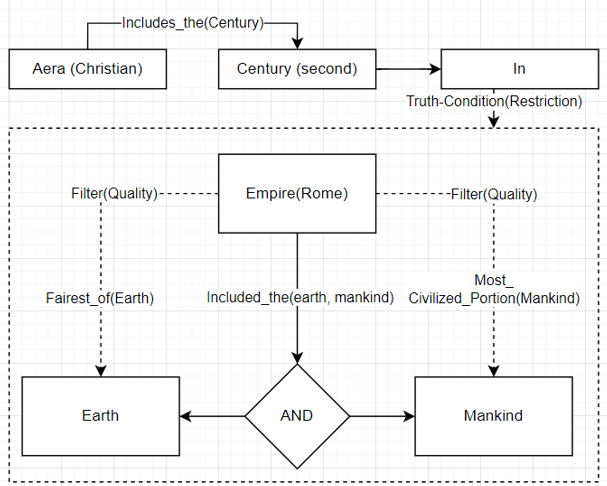
Structure - Dr. Pili Author
Structure – Dr. Pili Author

Natural language and set theoretical and formal logic reductions – A philosophical account

A sheer love for propositions – An obsession with analytic philosophy, logics and mathematics

Analytic philosophy was born out of the general problem of solving metaphysics through a careful diagnostic of natural language. After the early days of formal logics and set theory with Boole and Cator, Frege and Russell arrived at the conclusion that natural language spontaneously produces irreducible paradoxes such as the liar and the sorites paradoxes. Through the length of these paradoxes, they concluded that traditional metaphysics was a gigantic mistake, formulable as it was under mistaken conception of language. The idea was ingenuous and simple to grasp. If I use very bad components and tools, I can only produce flawed engines, whose appearance is similar to a working engine until we check it. This ‘diagnostic’ approach to philosophy is as old as the Greeks, who were the first to outline different ways to ‘unveil life-threating mistakes through reasoning’. This was firstly tried in the realm of ethics, especially during the Alexandrine philosophies.[1] Wildly differently, this was tried again by the founding fathers of analytic philosophy.

Frege elaborated an entire philosophical system out of a new conception of logics applied to semantics through the instruments of the ‘new’ developments in formal logic, a Leibnizian ideal language through which all problems could be formulated and, then, solved by ‘brute force’ calculations.[2] In this broad category I am including set theory – in fact, it is arguable that formal logics and set theory cannot even be thought independently in the human mind.[3] In the following writing, I will consider set theory as the broad category including naïve set theory and Zermelo-Frankel theory plus the axiom of choice (ZFC).[4] It could be a matter of contentious, but set theory is, itself, a parallel endeavor that overlaps with the development of formal logic as we know. Moreover, set theory and formal logics are intended to mirror one another, where the sets are intended to be the object-domain of the propositions formulable in a formal language.[5] Set theory and formal logics tied together for solving all the natural language’s problems posed to human understanding, or so the founding fathers of analytic philosophy believed.

A Pluralistic Understanding of Time – Time as Eternal truths

Abstract

‘Time is said in many ways’, to paraphrase Aristotle. In this essay, time is comprehended in four distinct yet parallel ways: subjective time, event time, conventional time, and landscape time. Subjective time measures the interval between two subjective experiences recorded by memory. Event time represents the order of events involved in a process. Conventional time is the measurement of a given physical interval registered by a clock and intersubjectively assumed as common. Landscape time refers to the current disposition of all changing facts in the universe. These four types of time are independent and autonomous from one another, as the essay will demonstrate. Although distinct, these time types can be related, collectively contributing to our understanding of the concept of time and how we use the term in language. The conclusion supports a pluralistic view of time, where time is partitioned into four categories, each explaining a distinct portion of reality.


Introduction – Time in the History of Philosophy

Time was not a major concern of the Greek-Roman philosophical tradition. From one side, time was conceived as the form of the appearances, that is of what it does not exist. Parmenides, essentially, banned time from his ontology, as the only things that exist is ‘the being,’ which was to be intended as eternal, meaning a-temporal, an object that does not change, hence does not exist in time.[1] Any subsequent metaphysical approach which endorsed implicitly or explicitly any form of Parmenidean ontology (something that does exist in its perfection because it never changes) is, in a way or another, banning time in a very fundamental sense.[2] Both Plato and Aristotle essentially (here intended ‘literally,’ i.e. in their understanding of what ‘really exists’) endorsed Parmenides’ vision. For some interesting reasons, today this notion is called ‘Platonic,’ but the conception of a perfect unchanging being independent from how things look like in and through time is, in fact, originated by Parmenides.


Dantedì 2023 – Una prospettiva sociologica del Dante uomo del Trecento

E. Delacroix - La Barque de Dante
Copyright: https://jenikirbyhistory.getarchive.net/amp/media/the-barque-of-dante-506ac6


Lettura di Inferno VIII in occasione del Dantedì 2023.

Introduzione:

In occasione del Dantedì[1] 2023, rivolto alla diffusione della meraviglia dantesca in ogni sua forma, è mia premura presentare un lavoro di analisi del celebre canto VIII dell’Inferno secondo una prospettiva più ampiamente sociologica, volta a dimostrare la peculiarità, di interesse storico, della mentalità dantesca che traspare. Si procederà dapprima ad una sinossi filologica di presentazione del lavoro dantesco per poi passare all’analisi interessata del celebre episodio di dialogo tra Dante e Filippo Argenti. Lo studio in questione è volto a creare dei ponti di collegamento con altri episodi tratti dalle tre cantiche, al fine di dimostrare come la mentalità dantesca, di impronta essenzialmente cristiana, differisse dai valori che, nella contemporaneità, sono attribuibili a tale etichetta. Fine ultimo del presente lavoro è presentare le sublimi peculiarità di Inferno VIII e, seguitamente, dimostrare come vi sia una netta ed insormontabile demarcazione tra l’ideologia politico-religiosa di un uomo del ‘300, puramente un uomo del suo tempo[2], e una qualsivoglia linea di pensiero, altrettanto politico-religiosa, della contemporaneità.


Inferno, canto VIII – una sinossi filologica e tematica

Ricostruire una sinossi filologica nello spazio di un articolo del presente calibro è impresa ben più che ardua, forse addirittura irrazionale. La tradizione di attestazione della Commedia (poi Divina a seguito del commento Boccaccesco) è caratterizzata da una sorprendente complessità a fronte delle innumerevoli attestazioni[3], tanto nella tradizione manoscritta quanto nella tradizione dei testi a stampa. Si tenterà pertanto di seguito di presentare una sinossi filologica delle prime attestazioni manoscritte, prendendo in esame due celebre manoscritti per un’analisi di taglio paleografico-filologico.

14 febbraio 842: i giuramenti di Strasburgo – Pillola linguistica

https://en.wikipedia.org/wiki/Strasbourg#/media/File:Strasbourg_Cathedral.jpg

Introduzione:

Pur non di meno valutando l’importanza della festa degli innamorati, di celebrazione ricorrente il 14 febbraio in onore di San Valentino[1], l’occhio di passion filologica non potrà mancar di notare come il medesimo giorno sia anche ricorrenza della sottoscrizione del patto di alleanza difensiva, conosciuto come Serments de Strasbourg (Giuramenti di Strasburgo), tra Lodovico il Germanico e Carlo il Calvo, figli dell’imperatore Lodovico il Pio (778-840), contro il fratello imperatore Lotario I. Il documento in questione, di datazione 14 febbraio 842 ma attestato unicamente dal posteriore ms. lat. 9768 BnF, di cui di seguito si propone la sinossi filologica, è riconosciuto come il primo documento cancelleresco di lingua romanza. La presente pillola linguistica si premura di presentare il documento dapprima sotto un punto di vista filologico e successivamente analizzando la patina linguistica che lo contraddistingue, dimostrandone l’importanza nella diffusione della lingua romanza di riferimento. Volendo dare un taglio romanzo alla presente pillola linguistica si andrà ad analizzare la varietà francese antica riportata nel giuramento di Lodovico il Germanico.

Contro le critiche di Searl e Putnam alla teoria della linguistica generativotrasformazionale di Chomsky

Σ, retouched by Wugapodes, CC BY-SA 4.0 <https://creativecommons.org/licenses/by-sa/4.0>, via Wikimedia Commons

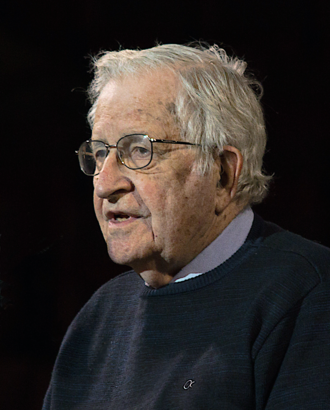
I limiti della teoria della linguistica generativo-trasformazionale ideata da Noam Chomsky sono piuttosto evidenti se rapportati alle idee della sociolinguistica che hanno preso piede nella società moderna, teorie che possono prescindere dall’universalità di Uriel Weinrich nel saggio Languages in contact del 1953.

Il presente saggio si premura di ipotizzare come le lingue siano costantemente in contatto l’una con l’altra nel loro dinamismo, un principio che è stato presentato sotto il nome di Teoria delle onde per spiegare come il contatto tra due o più codici linguistici sia la base delle mutazioni fonomorfologiche accadute in fase di cosiddetta grammatica storica. La vicinanza temporale delle teorie può renderle benissimo una l’ampliamento dell’altra, non vi è dubbio che la teoria di Noam Chomsky sia in determinati punti piuttosto sbrigativa e, per certi versi, inconcludente. Partendo dal presupposto che la teoria della linguistica generativo-trasformazionale di Chomsky si fondi sull’idea che il livello fondamentale di articolazione del linguaggio a finalità comunicative sia la sintassi, è superfluo asserire che la mancanza di considerazione dei livelli di semantica e pragmatica crei delle lacune che richiedono di essere colmate. E sebbene Chomsky, nella formulazione della propria teoria, non abbia tenuto in conto queste lacune, in fase di analisi sono assolutamente non trascurabili.

Opacità Referenziale – Possibile Non Assurdità Degli Enunciati Mooreani

https://it.freepik.com/vettori-gratuito/gocce-d-acqua-isolati-su-sfondo-trasparente_8308849.htm#query=pioggia&position=16&from_view=search

In questo post tratterò del tipo di enunciati definiti mooreani[1]. Tali enunciati sono composti da due parti congiunte da un connettivo logico: la prima parte (fattuale) enuncia che p; la seconda parte (soggettiva) afferma che il soggetto S non crede che p. Generalmente assumono la forma “p e non credo che p”, ad esempio “Piove e non credo che piova”.

Lo scopo che mi prefiggo in questo breve testo è quello di delineare alcuni specifici e semplici contesti linguistici ed epistemici nei quali è possibile emettere enunciati simili senza che si dia alcuna assurdità. Tale scopo è analogo a quello delle selfless assertions[2], ovvero delle particolari forme di asserzione in cui chi asserisce, per particolari ragioni, non crede a quanto sta asserendo.

Il ragionamento umano e le sue differenze con il ragionamento formale

Siamo sicuri di sapere come ragioniamo? Non come dovremmo ragionare, non come crediamo di ragionare, ma come ragioniamo effettivamente. Per almeno un secolo e mezzo, cioè dalla metà del XIX secolo siamo dominati dal paradigma della logica formale, che già si riallacciava al modello della geometria euclidea: pochi assiomi, pochissime definizioni, poche regole di inferenza e molti teoremi, la cui garanzia risiede nella trasparenza dei pochi assiomi, delle poche definizioni e delle poche regole di inferenza. L’idea era fondare l’intera matematica, qualsiasi cosa essa sia, su poche nozioni teoricamente trasparenti o inoppugnabili, la cui combinazione doveva essere garantita dai principi della logica. Da qui il celebre detto di Russell e Wittgenstein che nella logica non ci devono essere salti perché è il regno della banalità.

Il passo successivo è stato riuscire ad implementare tale linguaggio formale di natura combinatoria nei computer, che altro non sono se particolari sistemi formali (macchine di Turing universali). Alla fine, siamo arrivati a domandarci se queste macchine pensino, visto che seguono le nostre stesse regole quando ragioniamo. Non intendo addentrarmi in quest’ultimo problema, che va affrontato con altre risorse filosofiche (per esempio, Pili (2012), cap. 8 o per esempio il video qui), prendendo sul serio le teorie dell’intelligenza artificiale e del funzionalismo della filosofia della mente analitica. Invece vorrei dedicare questo articolo all’altro problema che, per altro, è raramente considerato, ovvero il ragionamento umano per come si presenta.