
Press "Enter" to skip to content

Mese: Ottobre 2025

VENERE IN CORNICE – La parola in sogno ha il galleggiante sulla scaletta / The word in a dream has a float on a stepladder

Benedetta Di Nunno immagina che ci si arrampichi su una scaletta fatta di sogni argentati. Con più realismo, prima il desiderio avrà lucidato la pelle. Per l’oro della trasfigurazione, bisognerebbe accovacciarsi su una veranda panoramica della galassia, contando le stelle per addormentarsi. Sabrina è stata inquadrata per uno scatto la cui estetica apparterebbe a Cenerentola. Seduta sulla scalinata d’un palazzo, lei porta un abito rosa a “macchie stellari” (dal nero all’argento). In alto, si scorge il piano da raggiungere. Si dà una una “sventagliata” delle mani, per tentare di “calzare la ringhiera giusta”, se la chioma informe della nuvola, oltre il motivo da siepe, non è proteggibile ma parabile (alla morbidezza che cela le vertigini). Lo sguardo di Sabrina ci pare sognante o perfino desiderante.

Benedetta Di Nunno imagines that we climb a stepladder made of silver-plated dreams. With more realism, at the beginning the desire would have polished the skin. For the gold of a transfiguration, we should be crouched on a panoramic veranda of the galaxy, counting the stars to fall asleep. Sabrina was framed for a shot whose aesthetics would belong to Cinderella. Sitting on the staircase of a building, she wears a pink dress with “starspots” (from the black to the silver). Above, we glimpse the floor that we have to reach. There happens a “fanning” of the hands, to try to “put the right railing on”, if a shapeless foliage of the cloud, beyond the motif of the hedge, can not be protected but can be parried (at a softness which conceals the vertigo). The Sabrina’s gaze seems to us dreamy or even desiring.

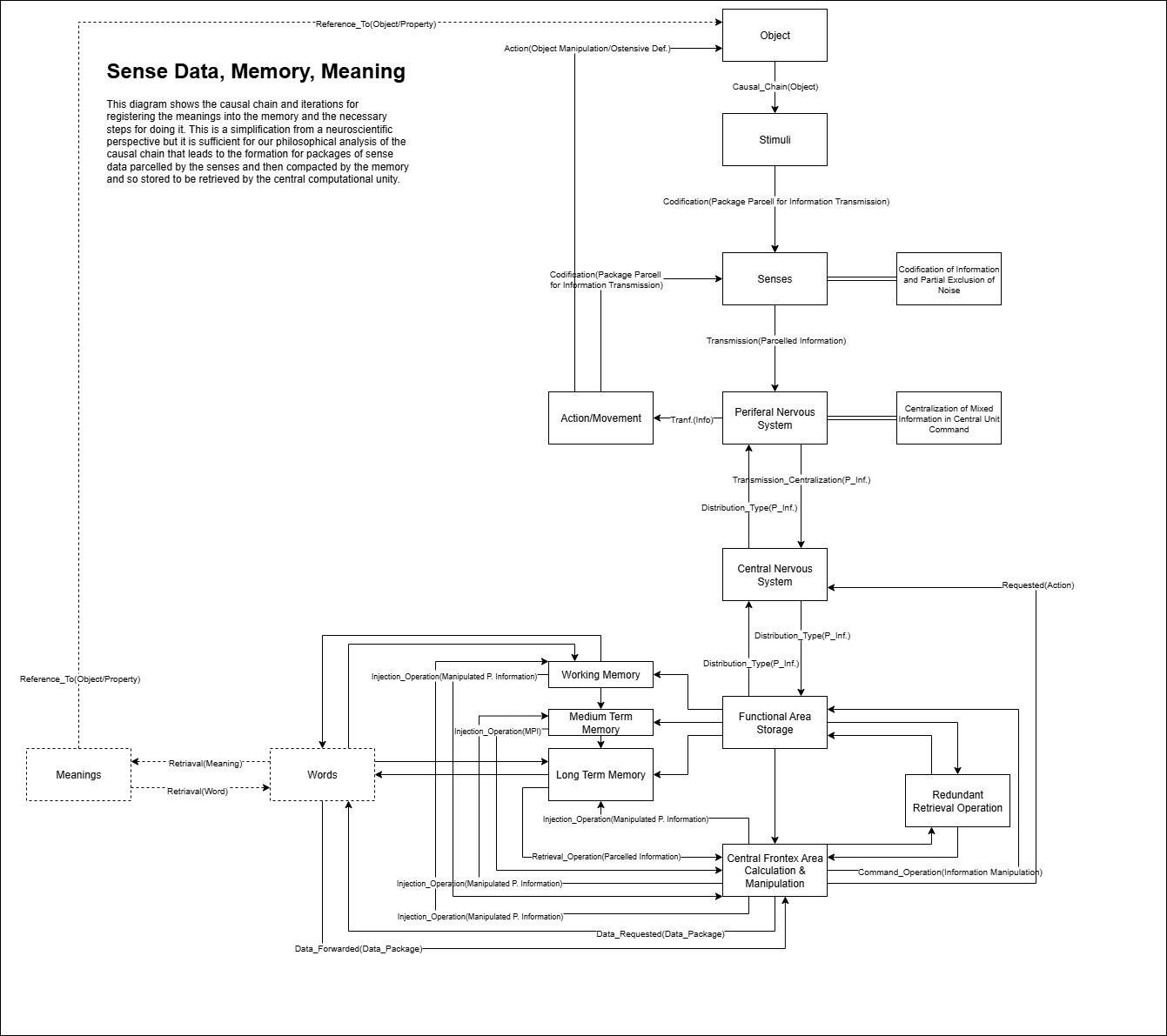
Memory, Meanings and Language – How We Think About Things

Memory – Copyrights Owned by the Author

How does language connect to the world? A simple, ancient question that should hunt every serious scholar in any field. For example, what do we mean when we say, ‘The army fought bravely against Nazi Germany’ or ‘All crows are black’? How can we connect an ‘army’ to ‘braveness’ and its ‘fighting’ ‘against Nazi Germany’? What do we actually mean by ‘all crows’? No matter how one wants to tackle the problem, this is quite an astonishing open-ended hurdle that every new generation of thinkers must recalibrate or reframe.[1]

Plato started the quest because of his idealist conceptualization of knowledge, which was understood only as perfect in terms of access to the ideas which, in turn, must refer to the world somehow. However, how to connect his ideas to a specific ‘table’ is not an easy endeavor and Aristotle tried to reverse the process: we describe ‘tables’ given the knowledge we get from every specific table. But then, how can we have a general notion of tables? From where this ‘generality’ comes from and how can it be justified? Ultimately, these answers can be partially given reformulating the problem in terms of meaning. The meaning of the sentence ‘the table is black’ depends on the meanings of its constituent components. What does meaning mean? We need to clarify what the meanings of words (in theory, all of them, including prepositions, indexicals, and prepositions).

Interestingly, so-called idealist philosophers such as Renè Descartes and Baruch Spinoza reinterpreted the idealist vision in subjective terms. Plato assumed that ideas are external non-causal entities existing outside the phenomenon and the mind. They stay there eternally unmoving mysteriously able to give us a real glimpse of a stable world. Firstly, Descartes reinterpreted this concept within the subject itself: ideas are stable construction of the cognitive subject whose access is granted by direct introspection whose strength is supplemented by reason. However, the grasp of concepts can be independent from reason, which has the primary goal to make arguments based on those ideas and concepts. Of course, Descartes had the same problem Plato had; that is, how to connect ideas to the world. In his case, he had to make a brilliant and convoluted argument based on the alignment between ideas and the world granted by God and by the general architecture of cognition.[2] Spinoza, partially endorsing and criticizing Descartes, extended those lines of arguments: not only ideas can be explicitly grasped directly through a special direct introspection (intuition) but reason is the sole means to grant justification in elaborating new ideas.[3]

Schizofrenia morale – Inconciliabilità tra Motivazioni e Giustificazioni

[Originariamente pubblicato in data 14 aprile 2024]

Megagreenleopard, CC BY-SA 4.0 <https://creativecommons.org/licenses/by-sa/4.0>, via Wikimedia Commons

Il campo delle teorie morali è variegato e causa disaccordi circa i piani della motivazione e della giustificazione dell’atto morale. Uno dei discriminanti per rientrare nel campo della moralità è certamente l’avere un’attitudine altruista, in quanto parlare di etica risulta strettamente connesso alla presenza dell’altro, andando oltre “io” e “te” (Singer, 1979). Il riconoscimento dell’altro pone l’agente morale nella condizione di essere un osservatore ideale, con capacità di astrazione dal contesto che gli attribuisce uno sguardo dall’esterno.