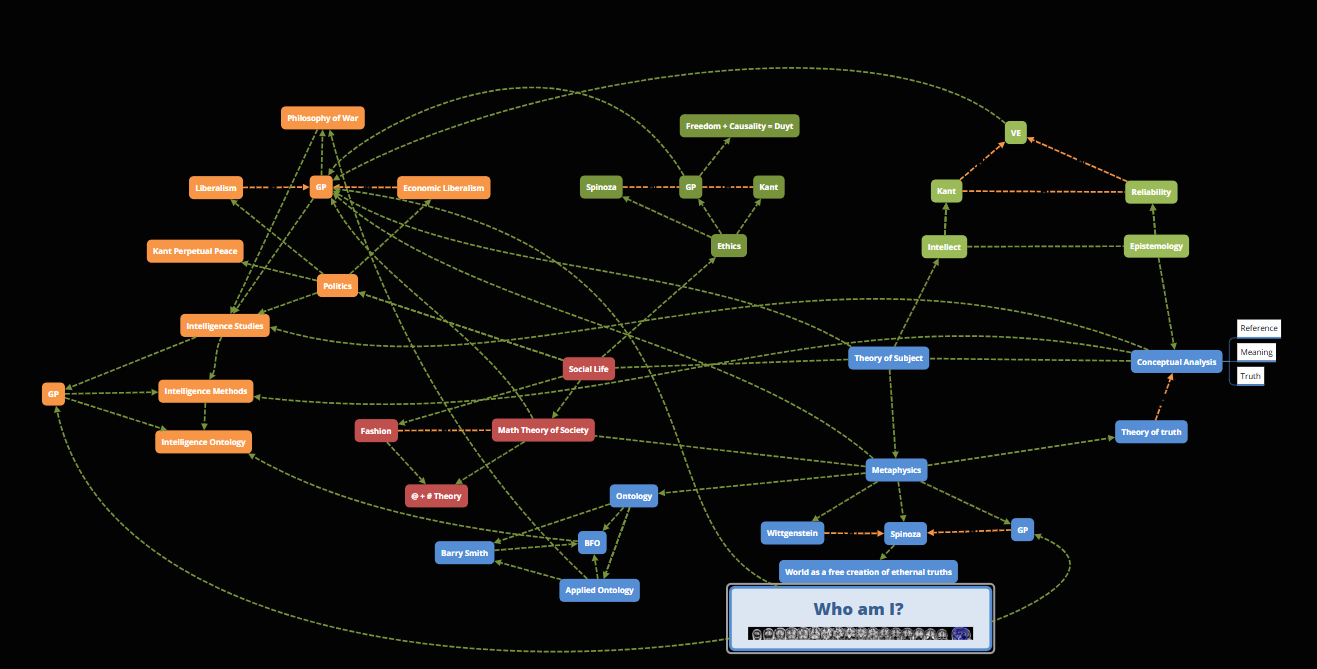
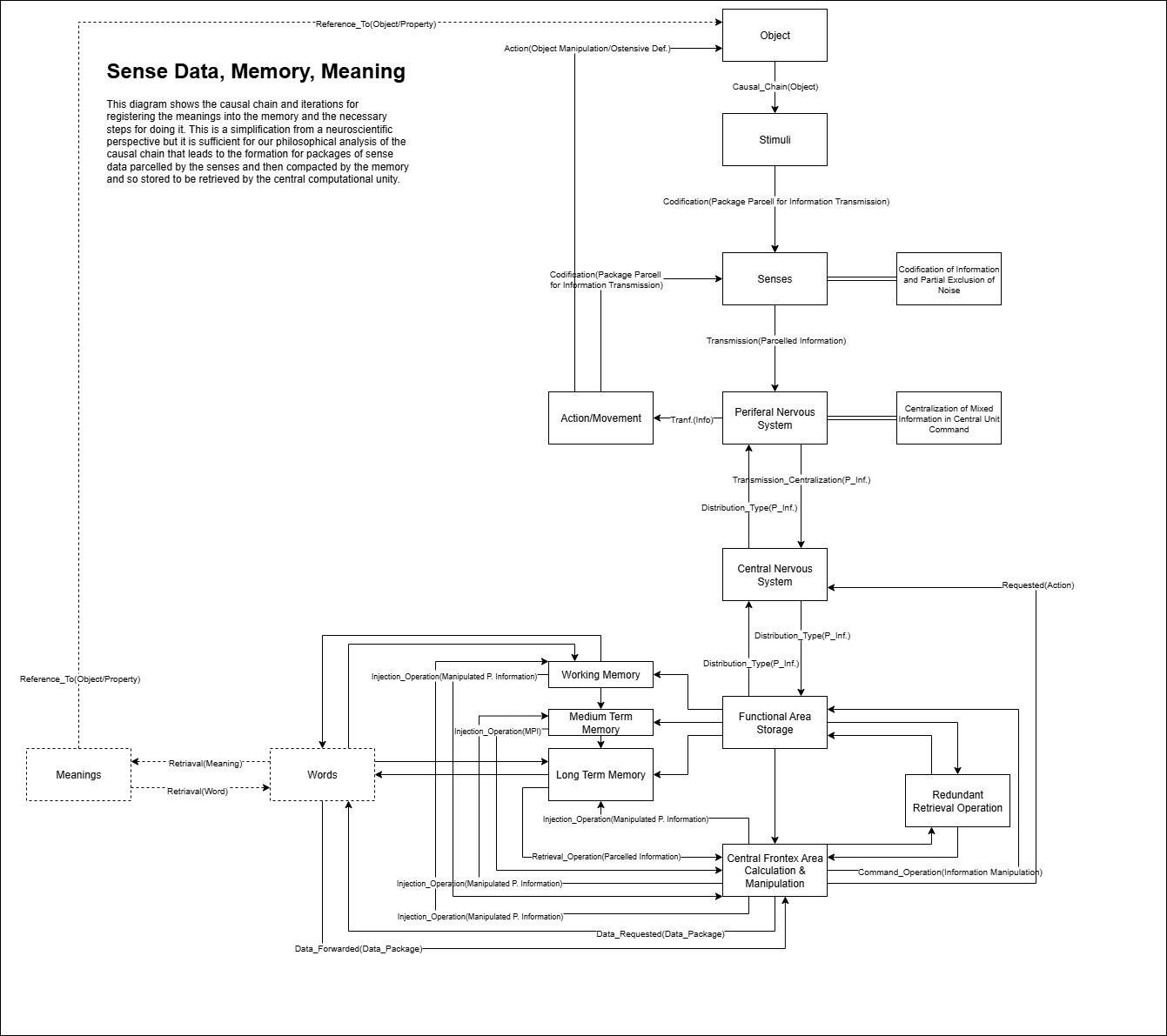
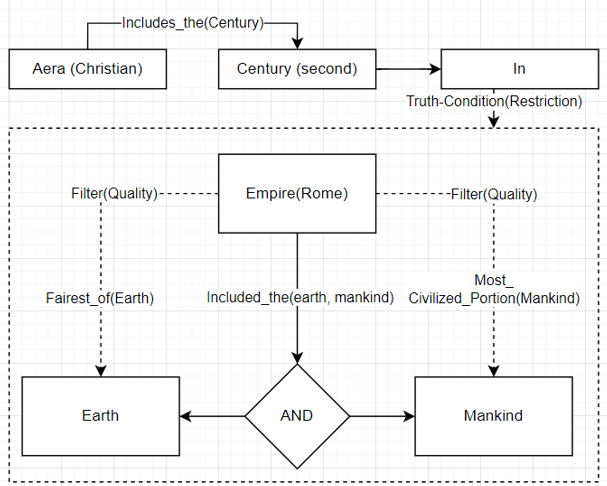
I recently read Philosophy of Physics – Space and Time written by the philosopher Tim Maudlin.[1] It is a short, dense book intended to be readable by everyone, but, as usual with these types of works, it requires very careful attention from the readers and effort to be unpacked, as we would wish from an excellent philosophical essay. Despite its shortness, Philosophy of Physics has been one of the most interesting readings on philosophy of science I have had in quite some time, not only because it had been a long time since I read a book or research paper in this philosophical area.[2] There are remarkable considerations in Maudlin’s work that would be worth an essay on their own, but here I am mentioning this reading because it has been the philosophical starting point for this essay, because it clearly posed specific ontological and epistemological questions when analyzing diagrams, mind maps and sketches.
Skepticism – Between a Malevolent Use of Language and Positive Philosophical Attitude
Introduction
Skepticism is an ancient philosophical attitude. I have been skeptical about many forms of skepticism and I still am.[1] My argumentation against it was that skepticism is based on a malevolent use of language to prove something clearly paradoxical or contradictory. In a sense, all skeptical philosophy is impossible in the strongest sense of the word ‘impossible’. The grounding of this conclusion is very simple. The skeptics are unable to prove what they want, and they construct arguments whose nature is self-defeating in a very fundamental sense.
However, at the same time, skepticism is an unreplaceable component of all philosophical edifices and, beyond them, all human thinking. Among the best philosophers were deemed skeptical at one point and the accusation was almost invariably right. They were skeptical about something specific, and their arguments were to disprove a portion of the assumed shared beliefs to replace them with something different, being it a reformist or creative endeavor. Here I try to show why both tenets are true: radical skepticism is pointless and yet we need some form of it. Understanding how this is not a contradiction is the topic of this essay.
Skepticism and Its Philosophical Relevance
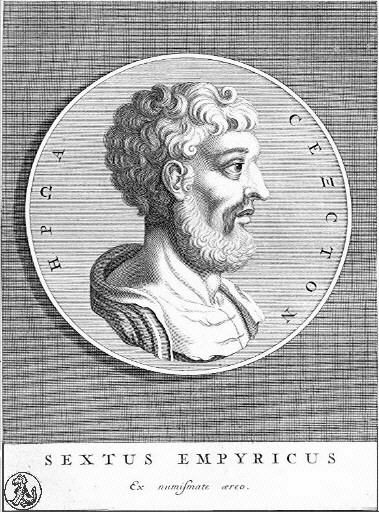
Skepticism is a philosophical attitude, not a philosophy. As an attitude, it is necessary and it consists in the unwillingness to accept anything as true or given or presumed beforehand. At the same time, this is not the primary objective of classic skepticism, whose goal was aligned with Stoicism and Epicureanism: peace of mind (ataraxia) from the ‘evils’ of the world.[2] We must start from the extreme form of it; that is, skepticism as a philosophy and not just as an attitude: “Sextus presents scepticism as a kind of philosophy, distinguished from others not by the content of its doctrines (there are none), but apparently by its attitude to philosophical problems and theses.”[3] According to this position, there is no solid foundation for any statement and proposition, no matter the origin, cause and formulation. The skeptical argument is the refuse of any possible argument at its extreme.
How does language connect to the world? A simple, ancient question that should hunt every serious scholar in any field. For example, what do we mean when we say, ‘The army fought bravely against Nazi Germany’ or ‘All crows are black’? How can we connect an ‘army’ to ‘braveness’ and its ‘fighting’ ‘against Nazi Germany’? What do we actually mean by ‘all crows’? No matter how one wants to tackle the problem, this is quite an astonishing open-ended hurdle that every new generation of thinkers must recalibrate or reframe.[1]
Plato started the quest because of his idealist conceptualization of knowledge, which was understood only as perfect in terms of access to the ideas which, in turn, must refer to the world somehow. However, how to connect his ideas to a specific ‘table’ is not an easy endeavor and Aristotle tried to reverse the process: we describe ‘tables’ given the knowledge we get from every specific table. But then, how can we have a general notion of tables? From where this ‘generality’ comes from and how can it be justified? Ultimately, these answers can be partially given reformulating the problem in terms of meaning. The meaning of the sentence ‘the table is black’ depends on the meanings of its constituent components. What does meaning mean? We need to clarify what the meanings of words (in theory, all of them, including prepositions, indexicals, and prepositions).
Interestingly, so-called idealist philosophers such as Renè Descartes and Baruch Spinoza reinterpreted the idealist vision in subjective terms. Plato assumed that ideas are external non-causal entities existing outside the phenomenon and the mind. They stay there eternally unmoving mysteriously able to give us a real glimpse of a stable world. Firstly, Descartes reinterpreted this concept within the subject itself: ideas are stable construction of the cognitive subject whose access is granted by direct introspection whose strength is supplemented by reason. However, the grasp of concepts can be independent from reason, which has the primary goal to make arguments based on those ideas and concepts. Of course, Descartes had the same problem Plato had; that is, how to connect ideas to the world. In his case, he had to make a brilliant and convoluted argument based on the alignment between ideas and the world granted by God and by the general architecture of cognition.[2]Spinoza, partially endorsing and criticizing Descartes, extended those lines of arguments: not only ideas can be explicitly grasped directly through a special direct introspection (intuition) but reason is the sole means to grant justification in elaborating new ideas.[3]
Natural language and set theoretical and formal logic reductions – A philosophical account
A sheer love for propositions – An obsession with analytic philosophy, logics and mathematics
Analytic philosophy was born out of the general problem of solving metaphysics through a careful diagnostic of natural language. After the early days of formal logics and set theory with Boole and Cator, Frege and Russell arrived at the conclusion that natural language spontaneously produces irreducible paradoxes such as the liar and the sorites paradoxes. Through the length of these paradoxes, they concluded that traditional metaphysics was a gigantic mistake, formulable as it was under mistaken conception of language. The idea was ingenuous and simple to grasp. If I use very bad components and tools, I can only produce flawed engines, whose appearance is similar to a working engine until we check it. This ‘diagnostic’ approach to philosophy is as old as the Greeks, who were the first to outline different ways to ‘unveil life-threating mistakes through reasoning’. This was firstly tried in the realm of ethics, especially during the Alexandrine philosophies.[1] Wildly differently, this was tried again by the founding fathers of analytic philosophy.
Frege elaborated an entire philosophical system out of a new conception of logics applied to semantics through the instruments of the ‘new’ developments in formal logic, a Leibnizian ideal language through which all problems could be formulated and, then, solved by ‘brute force’ calculations.[2] In this broad category I am including set theory – in fact, it is arguable that formal logics and set theory cannot even be thought independently in the human mind.[3] In the following writing, I will consider set theory as the broad category including naïve set theory and Zermelo-Frankel theory plus the axiom of choice (ZFC).[4] It could be a matter of contentious, but set theory is, itself, a parallel endeavor that overlaps with the development of formal logic as we know. Moreover, set theory and formal logics are intended to mirror one another, where the sets are intended to be the object-domain of the propositions formulable in a formal language.[5] Set theory and formal logics tied together for solving all the natural language’s problems posed to human understanding, or so the founding fathers of analytic philosophy believed.