

An Unexpected Journey into Everyday Thinking
Prologue – From Where All This Started
I recently read Philosophy of Physics – Space and Time written by the philosopher Tim Maudlin.[1] It is a short, dense book intended to be readable by everyone, but, as usual with these types of works, it requires very careful attention from the readers and effort to be unpacked, as we would wish from an excellent philosophical essay. Despite its shortness, Philosophy of Physics has been one of the most interesting readings on philosophy of science I have had in quite some time, not only because it had been a long time since I read a book or research paper in this philosophical area.[2] There are remarkable considerations in Maudlin’s work that would be worth an essay on their own, but here I am mentioning this reading because it has been the philosophical starting point for this essay, because it clearly posed specific ontological and epistemological questions when analyzing diagrams, mind maps and sketches.
Maudlin was induced to reflect on the underlying philosophical assumptions of diagrams to show how confusing or misleading some of the representations sketched by physicists and philosophers of science might be, and one must be very careful in interpreting them. As I am an avid drawer of sketches, diagrams, flowcharts, and any other sort of infographic, I never asked myself what I was doing or even what those diagrams were intended to represent, which is definitely rare, as I conduct self-investigations of this kind relentlessly.[3] Instead, I never gave any thought to something so important and obvious. Maudlin forced me to think very deeply about this ‘obvious but completely non-obvious’ topic, even more than about physics. The essay you are hopefully going to read is the result of my answers to Maudlin’s questions.
Finally, just after a brief check, I discovered the existence of what is called “semantic analysis and knowledge representation,” intended to use formal principles to visualize organizational structures of institutions or general managerial arrangements. This might be a branch of formal ontology, about which we have already had the opportunity to investigate in multiple places. However, we have drawn diagrams, sketches and any other informational non-artistic visual artifacts for thousands of years and, following Maudlin’s inspiring reading, I intend to clarify their philosophical implications regardless of the limited reading of formal ontological literature and its purposes. In this regard, formal ontologies and their graphic rendering offer only a very limited and recent portion of the object of this philosophical investigation.[4]
Introduction – What Does that Map Represent?
What do we do when we draw a diagram? What is the picture at the end? These sound like unthreatening, non-philosophical questions, and yet they imply deep ontological assumptions, one way or another. In a sense, when we show a slide, a diagram, a chart, or an infographic, we identify and characterize visually something. This essay explores how giving form to this something is not trivial and what its philosophical implications are.
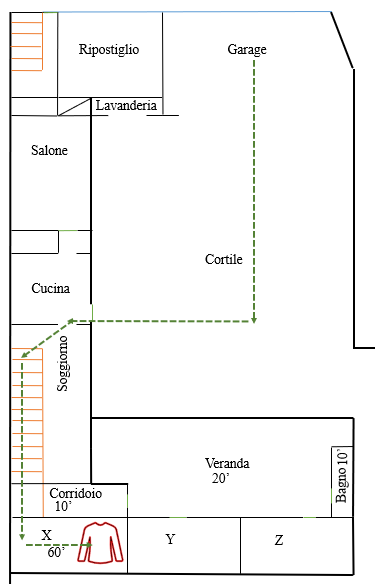
Let’s start with a thought experiment. I ask the reader to draw a map of their home to precisely indicate where the shirts are. Ideally, the sketch should be good enough for anybody to understand. They will likely include the front door, then a corridor and at least one or two rooms, and, in one of them, there will be a drawer or a place where the shirts hang. The map will likely include the line that represents the path toward the desired object, which will probably be outlined with a symbol or a label to indicate ‘here you find the shirts’. This might be done by sketching a shirt, or it might be an ‘X’ or the label ‘shirts’. Now, the question for the reader is: what does that map refer to, and what is its meaning?[5] And, generalizing from references and meanings: what does that map represent? Is it something about your mind’s organization or is it about how a piece of reality is? Maybe both? Difficult to answer ‘neither’. However, there must be an answer, at the very least because you have sketched that map. Now a real story.
Figure 1: A Map to Find my Shirts
A few years ago, I had to deliver a product to a customer. This peculiar person couldn’t believe that giving me his address would have been sufficient to find his house in the countryside. He repeatedly insisted on sketching a map to find his home. He took a dirty piece of paper and started drawing what I can only describe as a childish ‘treasure map’. I still have that sketch somewhere, as it was a treasure on its own. Once he finished his geospatial masterpiece, he asked to come closer to him as he had to show me the intricacies of the artifact. “You will have to turn on the second cross on the right, not the first!” He insisted, showing with his unsharpened pencil the ‘place’ where, he insisted, I could have made a mistake.[6] “Here! You see…?” he said, pointing repeatedly at the piece of paper with the blunt tip. The fact was that all I could see was a line with two roundish circles and one “X” at the end. I didn’t even try to argue, as I had his address, but when I showed the map to my coworkers, everybody laughed. That ‘map’ was absolutely useless. And yet there was something on that piece of paper that, according to this customer, meant something absolutely crystal clear to him. What was that?
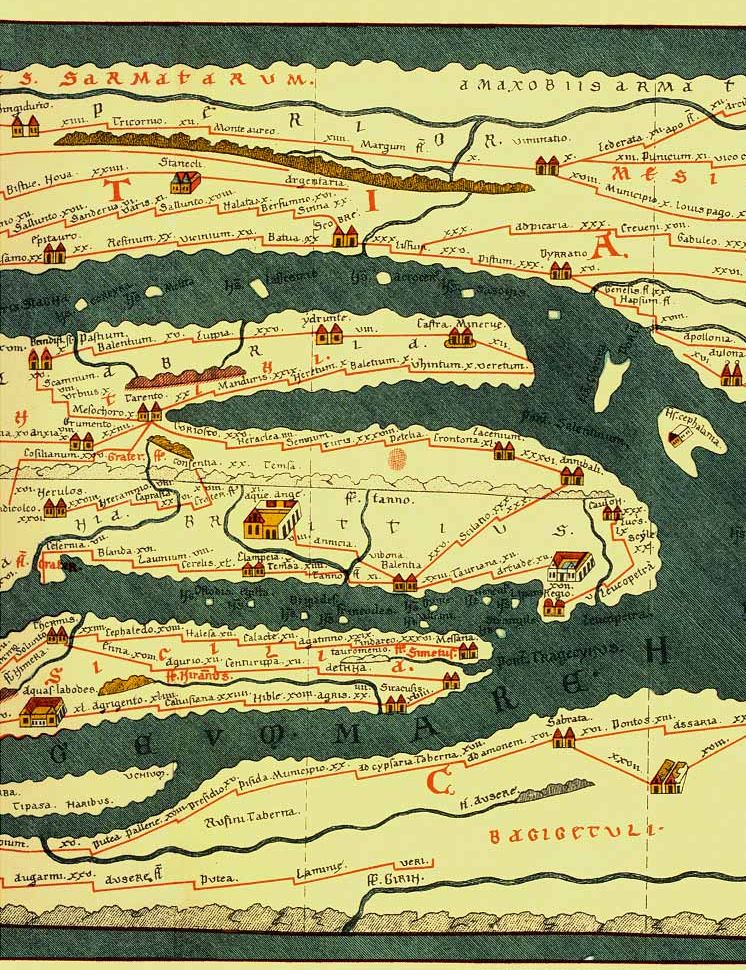
Some years later, after a tectonic shift in my life, I asked my students to draw a map “like the Romans. That is, create a map to show how a person could find the closest bus station.” Given the many cultural divergencies that I still discover every day, I was utterly surprised to discover that the first problem was to understand what ‘a bus station’ meant. This already shows that everything starts with language and that a statement can be visually represented only under the assumption that the meanings of words are part of the shared memory, as only then can someone try to understand where to find the references for them – that is, the external objects that make the statement true or false. If the words are misunderstood, whatever the graphic representation might be, it will be false or, even worse, misleading. Even after the clarification, the professor had his moment of satisfaction: no one was ever able to draw a map like the Romans, for the very simple reason that the Romans did not draw maps to provide directions. They had sketches like the one the customer had so generously given me, plus a lot of description like the one that the customer was providing, only written down alongside the sketch and likely in a more precise language. We simply lost the cultural habit of giving directions like ‘you will find the bus station if you turn your back on the main building, then you cross the road and go straight ahead until you find a crossroad with a stadium in front of you. Near the parking lot there, you will see the bus station slightly to your right’. This simple description with directions, maybe aided by a minimal sketch of the primary points, will be much more effective than trying to replicate what we now think a ‘map’ is.
Figure 3 A Sketch of an Original Roman Map without Descriptions
A map is nothing more than a diagram and a diagram is nothing more than a particular graphic outcome. Diagrams come with hidden philosophical commitments. Therefore, maps come with them as well as they are a particular subset of the general category of ‘diagrams’, here to be intended as a graphic representation of something. And here we start our philosophical assumptions of diagrams and graphic representations of our mind.
Diagrams and Hidden Philosophical Commitments – Ontology and Epistemology of Diagrams
Figure 3: A Flowchart of My Travels
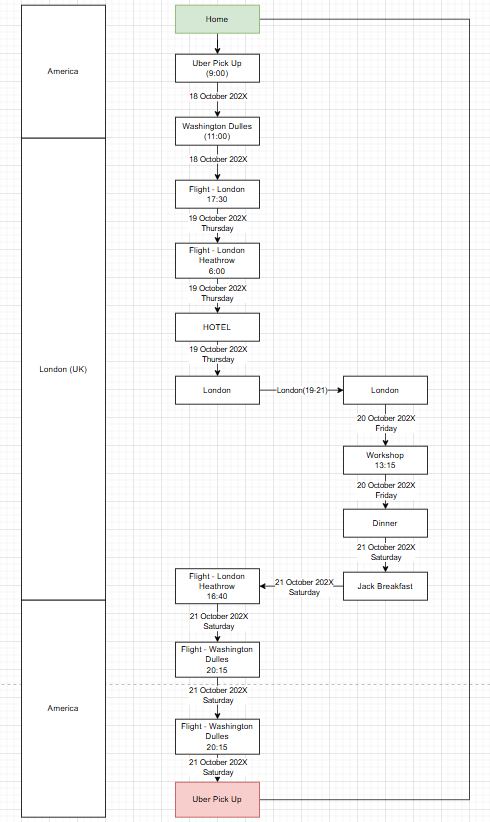
This is a real representation of the schedule and logistics of one of my travels. Every rectangle represents a different location whose description is briefly inserted into the geometrical shape. Inside them, there is also a time, and every rectangle is connected to the following one with an arrow indicating a date. The first and the last shapes are connected, as the end of the journey circles back to the starting place. I hope the reader can see that this is a system of representation, as every rectangle represents a location and every arrow a date. The combination of the two should give a good sense of my travels at any given time. In this description of the diagram, I used words such as ‘representation’, ‘represents’, ‘geometrical shape’, ‘connection’, etc. These all require an explanation, at least in general. What does the diagram represent?
A first intuitive reply from a non-philosopher might be, ‘It is a way to visualize your travel’. And then, ‘Yes, but what is visualized here?’ would be the immediate follow-up. There are two possibilities. The diagram might represent how an external observer might describe my journey, where I can be the observer of my own travels (and travesties). The observer would follow me to record where I was and when, like a detective following their target. Then, after having acquired the sense data gathered through observation, they would sketch the diagram to represent reality as it was at any given time, likely simplifying the transitions and skipping dead time, etc., by considering them ‘irrelevant’. In other words, the flowchart is intended to be a placeholder for a relevant piece of reality, where the relevance here is given by the goal or purpose of the observer: to describe my travels. In this conception, a diagram is a model of reality, that is, strictly speaking, a formal system of rules through which a function is associated with each sign, which, taken as a whole, can uniquely point to a portion of the world: the shapes, labels and arrows are the only items given, and they seem sufficient to do the job. However, even in this case, there is another possibility.
The diagram might not represent reality but how the observer conceptualized it. In other words, the representation is not of a portion of reality but of how the subject’s mind conceived it. It is a picture of a portion of the subject’s mind rather than a depiction of a given state of affairs. In this case, it would represent the general plan of the travel rather than the travel itself, with the rectangles indicating expected locations and the arrows the dates on which I will visit them. Notice how I shifted from the present tense to the future, exactly because the diagram would be speculative in nature and, as such, would be described through the future and conditional tenses. It should be clear now how the two positions diverge widely ontologically and epistemologically! In one case, the diagram represents a piece of reality, and in the other case, it sketches the architectural planning of the mind.[7] In one case, the epistemological goal is descriptive and in the other is prescriptive or oriented in sharing mind’s expectations toward the future. Remarkably, in both cases, there is a convergence over one crucial point: the diagram is qualified as a ‘sketch’ exactly because it is a model, whatever it might capture. As such, it does not report every feature of the reality described for the simple reason that it would be pointless. Let’s come back to the divergent interpretations.
A Realist Interpretation of Diagrams – A Sketch of a Portion of Reality as Reality Is
The first conception suggests that a diagram is a way to capture a portion of reality that we want to visualize for whatever reason. The components of the diagrams are then conceived as placeholders (symbols) for a portion of reality, comprising objects (a place, a fact, a state of affairs, or an action) or properties and relations (where something is located) at any given time (hours and dates). The symbols refer to those objects. This is universally applicable, independently of the nature of the objects. The reader must appreciate that different diagrams pose different ontological requirements or implications.
For example, a logical representation of an institute’s organization does not include time, as it intends to picture the structure sub species aeternitatis. Instead, in a flow chart like Figure 3, time is crucial, and it is indeed represented by arrows, as they intuitively suggest a direction to the mind.[8] Here, the point is just to appreciate that different diagrams have different ontological assumptions depending on what the diagram intends to capture. As a diagram is intended to represent reality, it can be understood as another way to formulate propositions about the world. In fact, any diagram can be translated into a full description.[9] While there is a possible complication in the translation from the picture to words, this operation is allowed exactly because a diagram is already based on a symbol system and, as such, can easily be translated into a series of propositions. Even more so, as the customer’s story proves, for any formalized structure, there is a natural language description of that very structure to be interpreted in the first place. Therefore, without natural language, any formal structure cannot be introduced and, essentially, intelligibly formulated.[10] If that is the case, then for any realist approach to diagrams, one can investigate how truthful the sketch is.
Indeed, using our current example, another subject might investigate the truthfulness of the diagram simply by asking whether the travel went that way or not. If I went to those places on those days and at those times, then the diagram would be a truthful representation, and if not, it would not. We could ask how committed we are to completeness. For example, we could establish whether the diagram would be ‘overall’ truthful. We can establish a simple correspondence rule such that the diagram is ‘overall’ truthful if the travel went as described almost all the time, but with some exceptions. Paralleling linguistic expressions, this would be tantamount to asking if a long description of a place is truthful only if all its propositions are true and whether it can be ‘acceptable’ if only most of them are. Establishing stringent conditions for ‘truthfulness’ in non-categorical terms for diagrams and long descriptions is not particularly relevant or straightforward here.[11] For diagrams we can stay a bit more relaxed, but it is important to notice how a diagram can be judged in this way: completeness and consistency. For example, if the diagram included that I stayed in two different places at the same time, that would have made it trivially false for simple logical application of the principle of contradiction.[12] This is important because it shows how a diagram is susceptible to purely formal scrutiny and demonstrates that, independently of the interpretation of its ontology, it is committed to general logical principles. If this is the case, then any diagram is a logical artifact of some sort.
Therefore, a diagram will be logically consistent if its sketch and well-formulated blocks cannot be translated into syntactically and semantically contradictory statements. Instead, it is complete if it includes all the pieces of reality that it is supposed to represent, at least those that are relevant, while the rest can be discharged. In the case of incompleteness, the only condition to be met is that its structure and symbology must allow the introduction of new blocks such that, with those blocks, the overall sketch would be complete and, obviously, still consistent. Finally, any diagram is loosely connected with reality. There must be a way to establish whether the sketch of my house with my shirts captures my actual house. For a realist, all that is required is that there is at least one way to validate the sketch. As long as the diagram captures something, it is doing its job. For example, in what way are the time arrows in the flow chart representing time? The fact that there is an arrow already suggest changes, as it is now intuitive to represent time in an oriented axe. For our scope and purposes, if there is a way to establish an agreement on how to measure time and a connection between the measured time and the sketch, the realist would be satisfied.
A Subject-Oriented Interpretation of Diagrams – Mind Drawing Itself
The second conception goes in the opposite direction. It does not commit to any external reality but only to how a given subject conceived of travel, regardless of how the travel went. For example, if the diagram was a representation of the travel schedule before I journeyed, then it cannot be committed to any stringent correspondence between its content and reality, as its execution would be known only post hoc. As planning is about the future, and there are many possible situations in which the plan can derail, the diagram does not represent reality for what it is but rather how I envisioned it beforehand. In this sense, however, there is still a conditional truth-value associated with the diagram. The diagram would be true if and only if that is how my mind scheduled the travel. Its truthfulness would be closer to pragmatic implicatures rather than conditional truth-values, as the diagram will be judged according to the resulting actions rather than by its capacity to model reality.
In this sense, the entire interpretation of the sketch would be different from how a realist might conceive it. The rectangles would be placeholders for movements, and the arrows would indicate when these must happen to execute the plan properly. However, once conceived, the sketch would still represent something, and in this case it is the subject’s conception of its own future actions through time. Therefore, the truth-conditions might be closer to those we might associate with fictional stories, where internal consistency is more important than any correspondence with reality. However, again, here the proponent of this interpretation might retort that there is a correspondence between the sketch and the mind that produced it. In this sense, the representational principle still holds, although it is differently directed than in the previous case.
Relevantly, the same logical conditions would apply to this interpretation as well. For example, I cannot be in two places at the same time, or I cannot move from one place to another without intermediate steps and those steps must be feasible etc. In this sense, both logical consistency and completeness apply as the plan would be incomplete if it does not include all the steps between a given goal and the way to achieve it. However, even in this case, one can ask for less than the full description of how to achieve a given objective as a diagram as detailed as reality would be useless and, ultimately, not a model of reality but reality itself.
Intersubjective-Constructivist Thinking about Diagrams – Community Agreements and How Friction Shapes Shared Representations
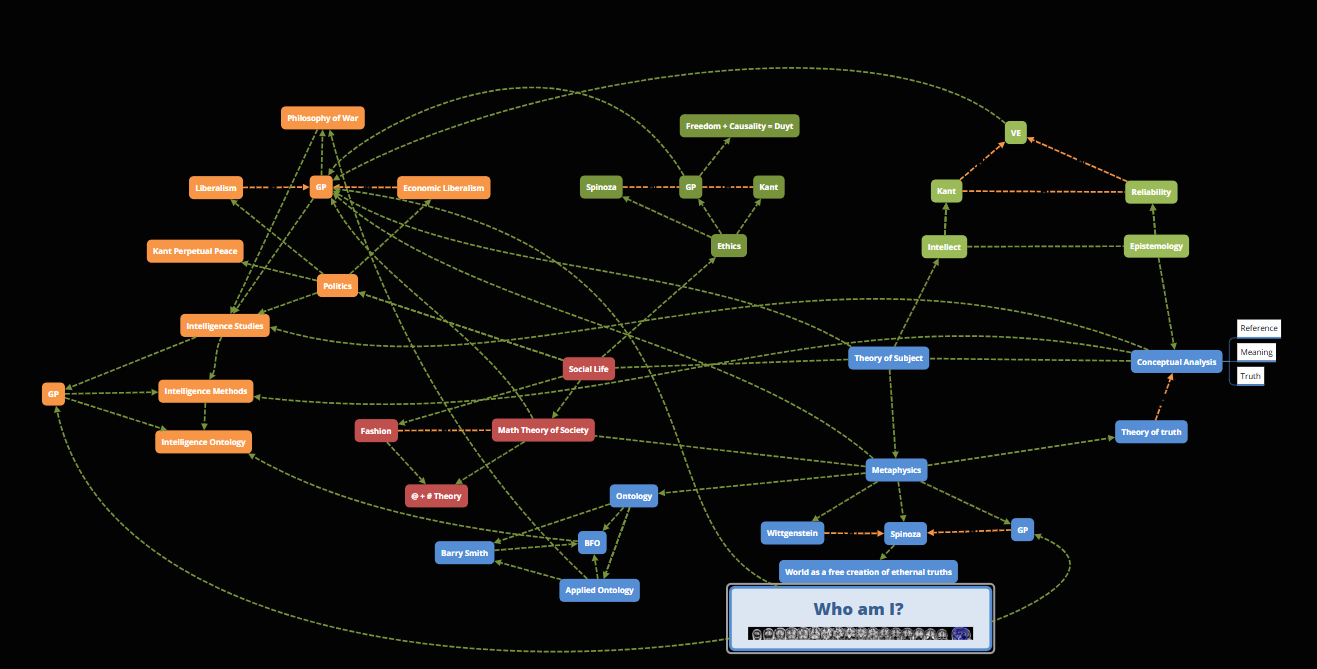
Diagrams’ interpretations show very neatly why I stand for non-unilateral interpretations, because the truth is that both interpretations, the realist and the subjectivist, capture something about what we want to do when we draw diagrams. There are situations in which we want to represent reality truthfully, and there are times when we want to envision or visualize our own mind’s conceptual landscape. This is particularly clear with the so-called ‘mind maps’, which are intended to show the relations between different theories or concepts. In that case, the purpose is to conceive how abstract concepts are related to one another, and such maps are quite useful for exploring ideas or intersubjective notions such as philosophical schools of thought and the like.
Figure 4: A Mind Map of My Theories
This example (Figure 3) is not even as extreme as trying to draw how I see my own theories (back in 2021), as they are only mine and, as such, completely referential to me. Instead, an intersubjective model of philosophical schools of thought might be tested against other scholars’ views and representations of the same theories, etc. The fact that there might be differences and divergencies only proves the possibility of an agreement. In fact, when we see a diagram of a battle displayed in a history museum, it represents how different curators and historians understood the historical event. It is not just a representation of reality but also a representation of how experts visualized it in a compelling way, with disagreements resolved through preliminary discussion and feedback. Similarly, any transport diagram is an intersubjective outcome of a shared institutional process intended to create a map showing how the transportation network is configured.
In this view, a diagram is a social construct intended to visualize how a given community conceived a given portion of reality. Intersubjective procedural interpretations of diagrams, like any form of constructivism, might diverge in their ontological conclusions. The sketch might be a standalone product of a given social community when it intends to visualize something that its members think is important. That is, reality is itself construed by the social interactions that ground the very possibility of that sketch. Before that social process, there was no visualization and, as such, no ‘reality’. In this sense, reality is the agreed categorization of a given possibility that might or might not reflect the world, as there might not be any world outside social construction. However, another interpretation of constructivism is not in conflict with the previous realist position, assuming that there is an ultimate independent reality which might be used to validate the truthfulness of that picture. In this sense, intersubjective agreement arises through each observer’s validation of the picture against the reality they intend to represent. Here, social negotiation would not be purely speculative or self-referential but based on the integration of different observations of reality from different observers. However, given that reality is one and the same for all, the picture would be intended as the aggregate of converging views of a similar state of affairs. In practical terms, the different members of the community should share all their evidence and be ready to converge on the overlapping and find ways to diminish the contours of the differences. Of course, it is assumed that if two members A and B with A’s set of beliefs as a subset of B and B’s set = A+B(n), then A should be ready to expand their own, in case B(n) contains only knowledge. Obviously, the same applies to B in case A and B have a positive intersection and what is excluded by both A and B is mutually understood knowledge. The problems emerge in the case in which the sets of belief include incompatible, contradictory or vague beliefs. In those cases, A and B discuss their divergences and they shall select what to include depending on how stringent the conditions for agreement might be. The process exemplified shall be generalized for any community with more than two members, while the bigger the community, the more complicated is the convergence process. As this is unimportant here, I won’t delve into the intricacies of social interactions.
Figure 5: A Military Diagram for Fire and Maneuver
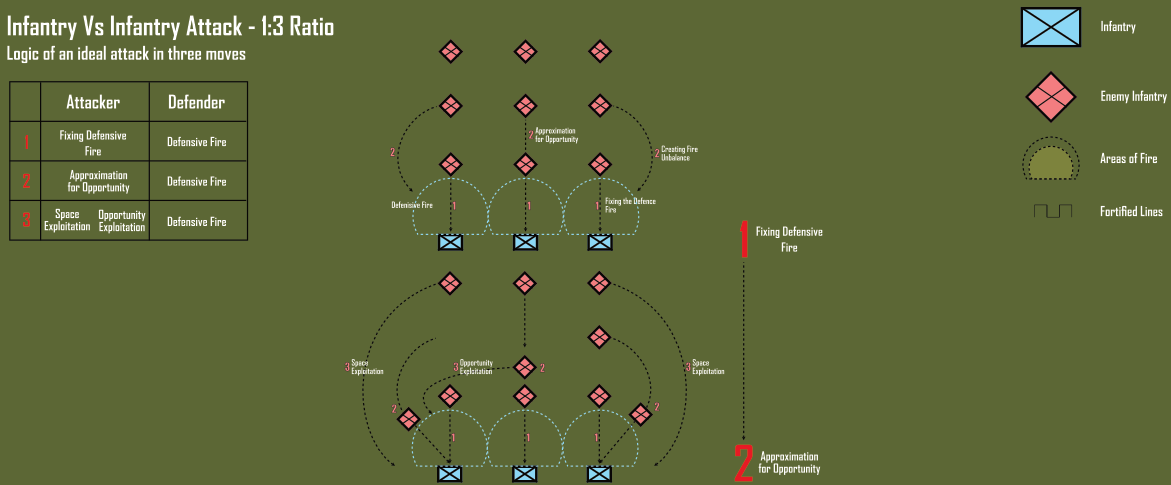
Let’s take Figure 4 as an example. It represents a classic scheme for ‘fire and maneuver’, where the attacker has six infantrymen and the defender has three. In the case of a historical battle, every single unit must be tracked back factually, where ‘factually’ primarily means that documents available to researchers testify to the presence of that unit at that place. Similarly, every movement should be documented somehow. The problem is that usually we do not have access to any historical document that is sufficiently detailed to reconstruct what actually happened. Instead, we most often have incomplete descriptions and partially logical reconstructions based on the accounts of witnesses and the work of the historian, who subsequently brings coherence to potentially wildly different accounts. As wars are messy and chance is everywhere, battle reconstructions are incomplete by necessity.[13]
Usually, the historical community engages in extensive debates on where and when those units were located most likely, where ‘most likely’ refers to where those soldiers could have been active at a given time. The inevitable speculative component of any historical reconstruction is the aspect over which the debates are more heated. It might be that a unit was not located as precisely or that its movement was not as ideally precise, etc. Perhaps they lost themselves because a given map was confusing or difficult to read, etc. Hence, assuming Figure 4 is a historical diagram, then the community shall converge on the locations and movements of a given unit at any given time that the strongest evidence seems to support. This might lead to compromises and the acceptance that the diagram might only describe an idealized scheme of what happened. In this sense, it captures the general structure (the aggregate of units’ movements and actions) of a battle, but it does leave open alternative possibilities which are sufficiently close to the one proposed.[14] Here constructivism would be perfectly compatible with realism. But there is another way to think about this diagram.
Let’s assume that Figure 4 is how a community wants to conceptualize how fire and maneuver play out, as if Figure 4 were part of a field manual. In this case, similarly to the subjective interpretation of sketches, the community might try to agree on an ideal case, an archetype to teach future generations of soldiers how this military plan works. In this case, the community will likely converge toward what they think, as an aggregate, the general case might be. Then, the representation would be deliberately idealized, with perfect geometries and successful execution of the movements, to show the goal and how to achieve it in the absence of contextual complications. This is how examples of physical experiments are represented in textbooks. These considerations could lead to two different ontological interpretations.
The first would be that the diagram is an agreement within the community over a given configuration of the possible without friction. The second would be disjointed from any commitment and only intended to understand or visualize how the community itself thinks when its members discuss fire and maneuver. In this latter interpretation, the diagram does not have any further correspondence beyond what the social aggregate establishes, through social interactions, as fire and maneuver. There is no further commitment to any external or internal reality beyond what was established during the construction process. While this latter interpretation comes with philosophical hurdles and is compatible with current popular philosophical approaches, it shows all its weaknesses, as it seems to lead to an empty shared mental exercise.
At least in my understanding, any reasonable constructivism is such that the social construct is based on individuals whose views are negotiated against all others, and the result is the agreement on a selection of evidence across the community that established the need to depict a state of affairs, an event, or an action. It is possible to conceive a socially constructed sketch that does not refer to anything in the world, but only to how a community thinks about a given problem or value. But here again, the purpose of the exercise would not be blindly to agree on something vaguely abstract, but to arrive at a collective conceptualization of an agreed common understanding. As such, there is still a principle of validation and falsification at play, which is the capacity of that given community to formulate a valid, common, shared understanding of a given situation in the abstract. The process fails when some portion of it is unconsidered or unrepresented. Logical principles, completeness and consistency requirements, still apply to constructivism independently of its ontological interpretation. In this sense, what is emerging is indeed how logic is more universal, because more abstract, than any ontological interpretation of it. No matter what we want to represent and how, it must be logical. However, as seen, ontological interpretations are central of diagramming exactly because the ultimate goal is to structure a model of something that might be mimicking reality, whatever it might be.
Why Unilateral Interpretations Fail to Capture the Full Picture – Connections between the Realist and Subject-Oriented Interpretation of Diagrams
My general understanding of any philosophical approach is very close to what other philosophers have pointed out, for example, Immanuel Kant in his writing on logic. The primary point is that any conception based on strict and specific evidence is one-sided and tends to ignore the counterarguments or opposing evidence. We should aspire to be as inclusive as possible of other perspectives, as they capture missed evidence we might have missed and something deep and important about reality, which is always more complicated and complex than our simplifications. Our simplified models might capture something better than taking by considering all possible data points or concepts together. The approach should always start with dissecting by dissecting all possible possibilities and only after trying then trying to give back reconstruct the original starting point, now fully clarified. This analysis on of diagrams is a perfect case in point.
The realist approach is better suited to describing those sketches whose purpose is entirely exhausted by representing reality as reality is it is at to the best of our abilities. While this would lead to a model, which will would exclude the noisy components of the crude case studies, the result will be a diagram as faithful to reality as possible, where the testing conditions will be akin to those of any correspondence theory sufficiently able to accommodate a cone of indeterminacy in the contours of the verification process. It does not matter that the procedure for establishing the truth-value of a diagram or a map might be difficult to ascertain. The only point is that there is at least one intuitive way in which this can be done. But we have already seen that this is not all we want to draw or visualize. A realist can still claim that when representing the subject’s planning, there is a sense in which this ‘planning’ must be somewhere, that is, in the mind of the subject. Hence, they can contend that such a diagram would be true if it captures the structure of the subject’s mind. However, this might lead to extreme conclusions over regarding idiosyncratic elements in the diagram, which were supposed to be readable only by the subject and, as such, completely arbitrary. That is why it seems that the subjective interpretation seems to remain preferable when expressing planning, self-referential concepts, and so on, as ultimately the subject expresses their own internal structures.
The subjective interpretation of diagrams shows a completely different side to the sketches themselves, that is, how our subjective categories are applied when freed from any representation of reality. This should not lead to the intuitive, and absolutely erroneous conclusion, that subjective representations of portions of the mind are completely arbitrary. Exactly as the realists ask, there are stringent limits under which a subjective diagram makes sense or does not. The subject is unable to think any differently and, if they want to be accurate, they need to respect all logical principles we outlined before. There is no escape from that. If a realist or a subjectivist would counterargue that our set of beliefs might be contradictory, the answer is that this is not a problem. This is why we draw the diagrams in the first place: to check whether our internal conception or understanding is logical or not. As such, in the presence of logical inconsistency, the diagram shall outline it so that it can be updated and amended. Exactly because every subject has slightly different meanings associated with different words and, therefore, they conceptualize the world slightly differently, a good diagram of this type would be the one able to replicate exactly these distinctions for each subject. There is no need to ask for convergence unless the goal is to reach an agreement with a given community, in which case, the subjective sketches should lead to a discussion and integration of others’ points of view on the same topic. This is why constructivism is not entirely wrong, as it is a powerful procedure to aggregate dispersed knowledge whose synthesis should be based on careful convergence on what is shared as known and on the creation of clear contours where divergences outline conflicting evidence or contradictions.
Intersubjective constructivism is not a middle ground but a completely different approach to diagrams and knowledge in general. As we have seen, social constructivism is compatible with both subjective and realist interpretations depending on what the community intends to represent. However, it can be perfectly disjointed. As a result, intersubjective constructivism becomes invaluable for understanding how different individuals might converge toward a common ground, even when every single subject interprets or ‘sees’ reality slightly differently. Nonetheless, given the fact that all subjects work under similar structural categories and the mind is not free to decide whether the principle of contradiction applies or not, they shall converge minimally on the form of the diagram and maximally on its content.
What usually happens is that the different subjects share their meanings through statements, and they adjust their knowledge of the world in light of the knowledge shared by others, converging on a common jargon that, ultimately, will produce the visual diagram. Constructivism is important for creating any artificial artifact that is not intended to fully represent reality or any subject, but rather a social agreement over the best interpretation of what is intended to be captured in the diagram. As such, there is nothing wrong with different scientific communities arriving at slightly different representations or conceptualizations of a given phenomenon, provided that these remain recognizable by any subject willing to understand them. When constructivism applies to reality or to a specific subject, then it conflates with realism or subjectivity, and, in those cases, constructivism does not imply an ontologically standalone position but rather a process whose purpose is a specific way to represent a given object, whether it is a piece of the world or a subject, here each intuitively understood as distinct and considered in its own uniqueness. Here, the mistake on the constructivist side is to extrapolate from their creation and generalize it as if there were neither a commitment to reality nor to the subject or anything else. It is in this specific way that constructivism marries aligns with relativism, where instead this might be true only although this might be true only under self-imposed ontological constraints. But both a realist and a subjectivist are allowed to counterargue against this improper generalization. While they should understand the purpose of a socially constructed artifact intended to be the pure representation of a given community, the constructivists should accept their own limitations.
As a conclusion, any diagram brings ontological commitments that lay lie on a spectrum of alternatives, which should not be conceived as mutually exclusive but, quite the opposite, as mutually reinforcing. As a result, considering that diagrams, maps, and sketches are all the result of purposeful actions, they always come with a very specific end in mind.
How Epistemology Drives Ontology – Epistemological Considerations about Diagrams
Thus far, we have only considered diagrams’ ontological assumptions and logical underpinnings, as they are absolutely fundamental to understanding what a diagram works and represents. However, any diagram is an artifact of some sort and, as such, is the result of a purposeful action. By definition, any purposeful action is driven by a goal, that is, a dispositional belief intended to express an intention to bring about a future state of affairs. Therefore, any diagram is a means to an end, and, as any diagram can be substituted by a description, any description is also a means to an end. After modern philosophy challenged the notion of teleological causality and tried to eliminate free will in too strong a sense, ontology and epistemology became self-isolated themselves from action when, in fact, they are only a reflection of the purposeful, inquisitive mind that struggles to understand reality. At their best, both ontology and epistemology should help in clarifying the world in such a way that better decisions and a better life are possible. This was stated even by Kant, who argued that any philosophy that does not bring any positive change to the subject must be discharged as pointless. Similarly, in this essay, I have tried to show that diagrams have deep philosophical implications and operate, when they do, under severe logical constraints. However, any diagram is pointless if it does not point to something – specifically, if it does not help us achieve a given goal. This goal is intrinsically epistemological.
Independently of how we are going to interpret the ontological commitments, any diagram is produced by an intentional entity to be used by an intentional entity (where the author might be the reader). If a diagram is sketched out, it is because of a given need on the part of the author, whose primary intention is to externalize and visualize the identified target. This can be internally or externally oriented, but the orientation is universally based on the purpose of conveying a message through an act of representation. As we have already seen, if this ‘message’ is a model of reality (here intended latu sensu and including the subject themselves), it is a logical consequence that this model was produced intentionally because of the subject’s need to convey it to someone, including themselves. Depending on the purpose of the representation, different commitments come along, and the reader of the diagram can question the author about their execution, introducing a resisting or opposing force which the author likely will already have factored in during the production phase. If any diagram is a model of reality intended to represent a given state of affairs, this intention is epistemological, as this representation will ultimately inform the receiver. That’s why a diagram can be legitimately translated into a finite series of propositions. Therefore, any diagram is sketched by virtue of a given representational goal that will ultimately be judged by a third party and, as such, the primary intention is driven by an epistemological goal or, in other words, the intention to convey a given set of beliefs about the world.
Let’s assume that this is the case. How can we even describe a diagram without assuming an informational need on the part of the author? Assuming the opposite to be true, we might conceive of a diagram that is unintentionally produced. But this is clearly unthinkable. We can imagine a diagram that was then interpreted differently or brought up a property of the world that we had not conceived of at the beginning. But producing a diagram without the intention of doing so is simply impossible. Hence, any diagram is intended for an epistemological purpose. It is the different epistemological driver that leads to different ontological attitudes toward diagrams. When we discussed all the ontological commitments and different alternative views, all of them started from the implicit precondition that the sketches were intended to represent something. Objecting to what is being represented itself changes the ontological perspective, and all the examples showed this switch in possible interpretations depending on the epistemological intention behind the diagram. This was explicitly laid out for Figure 2 (the sketch of the travel planning) and Figure 4 (fire and maneuver). Therefore, any diagram is primarily an epistemological outcome intended to convey a model of reality. Only philosophers can really arrive at the point of detaching themselves from the normality of life and come to believe that an ontological representation (whatever the form) is not committed to understanding reality better as it is, whatever reality might be. This brings us to another interesting conclusion.
If a diagram can be translated into a finite series of propositions, and if this translation can be faithful, then any diagram can be substituted by a description. We have already established that this is indeed possible, as both descriptions and diagrams can model reality and must respect general formal logical principles. If this is the case, then we can conclude that diagrams mean what the corresponding propositions mean. Therefore, the reason why diagrams are ultimately both useful and possible is that they are logical devices through which we represent reality using a combination of symbols, formal rules of association, and functions, thereby capturing a portion of reality while being more formal than natural language and more intelligible than formalized expressions. It doesn’t matter that translations might run into difficulties because, again, the very fact that at least partial translations are possible proves that some complete translations are also possible, hence establishing that diagrams can be translated into propositions. Finally, this shows another important feature of diagrams and sketches of any sort: they are primarily analytical devices, as what they do is describe a portion of reality that was already known, rather than help us observe it. Any diagram or sketch can exist only after a given portion of reality has been investigated. Even when we produce intermediate sketches, they are, in fact, imperfect and often lead to illogical results. A good diagram is one that brings clarity to our understanding, which means that this ‘understanding’ was already present in our memory and had been recorded somewhere.
Thus, diagrams are logical and formalized (or formalizable) artifacts that must comply with established logical principles. However, they are also products of applied geometry, usually but not necessarily Euclidean for the simple reason that we draw on a piece of paper that is almost universally flat.[15] This brings its own problems in the case of complex physical objects’ representations, as Tim Maudlin argued. Therefore, unlike language, diagrams of any type are intrinsically bound to what can be geometrically represented. However, as geometry can be understood as a series of logical propositions about geometrical entities, there is no further complication on our side, beyond the fact that a sound diagram has to comply with the constraints of geometric representability. While these considerations do not lead to the misleading conclusion that diagrams are infallible ways to represent any portion of reality, they should reassure the reader that there are stringent logical, geometrical, ontological, and epistemological reasons why they work.
Conclusions
When my customer gave me the ‘treasure map’, that sketch meant something genuinely to him. It was a very good example of a bad diagram intended to improve my knowledge of his location. However, while trying to portray reality, the customer actually portrayed his memory, and, as practical people often forget, their mind is not the world, though it is all they ‘know’.[16] As a result, instead of drawing a faithful picture of reality, he jotted down his own limited understanding of space. The epistemological goal cannot be clearer: to indicate to me where his home was. His failure only proves that I understood his intention while failing to grasp the description he wanted to convey. If that ‘treasure map’ had been fully translated (as it partially was) into a detailed description through natural language, the propositions expressed would have referred to the customer’s house and route to it, and they would have expressed what his own semantical model stored in his memory represented. However, given the nature and quality of the sketch, the result was ultimately a bad representation of what he thought the route to his home was. And as my mind and meanings were sufficiently different from his, my capacity to decipher the message failed. Fortunately, not all diagrams are like that, and they remain a critical analytical tool at our disposal to better understand the world or how we understand it.
I loved diagrams to the point of obsession, and I wanted to explore what their ontological commitments are while being epistemologically driven. I also tried to show why diagrams are legitimate logical and analytical artifacts intended to clarify, rather than to expand, our knowledge of the world through tailored, limited models of its portions. I hope I succeeded and, if not, I will jot down another diagram for you!
[1] Maudlin, T., Philosophy of Physics – Space and Time, (Princeton: Princeton University Press 2012).
[2] See Pili, G., “Kuhn e la struttura delle rivoluzioni scientifiche”, Scuola Filosofica, (2015), available at: https://www.scuolafilosofica.com/4624/thomas-khun-e-la-struttura-delle-rivoluzioni-scientifiche
[3] Scuola Filosofica is a gigantic testament of this effort when it comes to philosophy and other related fields.
[4] See Pili, G., “Ontology as Systematic Classification System”, Scuola Filosofica, (2020), available at: https://www.scuolafilosofica.com/8912/ontology, Arp, R, Smith, BD & Spear, AD (2015), Building ontologies with basic formal ontology, The Mit Press, Cambridge Mass, Křemen, P, Mička, P, Blaško, M & šmíd, M 2012, ‘Ontology-driven mindmapping’, Proceedings of the 8th International Conference on Semantic Systems – I-SEMANTICS ’12. See Pili (2020) for more references.
[5] For my interpretation of meaning and reference, see the deep dive in Pili, G., “Memory, Meanings and Language – How We Think About Things”, Scuola Filosofica, (2025), available at: https://www.scuolafilosofica.com/12854/memory-meanings-and-language
[6] I am sorry, I cannot stand unsharpened pencils.
[7] We will see that there is more to this, but here it will suffice to have the starting point clear enough.
[8] Interestingly, Wittgenstein posed the conundrum of their interpretation. But his point is weak as it can be explained that our standard interpretation of arrows is based on our psychological machinery.
[9] A description is a series of propositions that can be formalized in propositional first order logic such as for any a, P(a).
[10] This interesting and deep topic will be the object of another essay, but the main point here is in fact that any formalized language is a subsection of natural language, and it is natural language the place where we start conceptually and chronologically. I ask the formal logician reader here to formulate their formalizations without knowing how to interpret the formal symbols. Those ‘interpretations’ are given through rules of association such that to any portion of the formal system there is a function or a formal meaning associated with it. As a result, the ‘interpretation’ of formal symbols is tantamount to their introduction. This can be done only starting from natural language exactly because formalization is a subset of what is possible according to general linguistical conventions whose formalization is intended to clarify, but they must be present in the first place. For example, the first characterization of the principle of contradiction is offered by Euclides, Aristotle and likely firstly applied by Parmenides in ancient Greece. This principle was firstly given in natural language and only after many centuries we formalized it as “a ˄ -a = 0” with ‘a’ as any well formulated proposition that can be true or false, ˄ as ‘and’ and = ‘equivalent to’ and 0 = False. Notice how this is a graphic representation intended to be a scheme for any proposition in any language, including the natural. The reason we introduced that specific symbology, partially drawn by mathematics, is because it is less ambiguous. For example, ‘˄’ and ‘and’ might be different between formal and natural language as ‘and’ might include an implicit ‘temporal’ meaning and use into it as shown by pragmatists. Instead, logically, the order of the propositions jointed by ˄ is irrelevant. In essence, any formalization is another way to represent a portion of natural language and without natural language is quite literally unthinkable.
[11] I tried to tackle this problem in Pili, G., Filosofia Pura della Guerra, Rome:Aracne, Part II, Chap. 5 and specifically in the chapter devoted to understand the role of military history in war.
[12] Notice how decision trees are not contradictory as for any possible decision there are at least two different alternatives with a and -a as diverging possibilities in which a given subject is either at a or at -a but not both. Decision trees might mimic other interesting formal logical structures.
[13] To make a historical reconstruction complete, the historian would have to know what every single soldier did at any given time during the battle, which is obviously materially impossible. How can be possible the opposite? Maybe every solder dutifully reported what they did immediately afterwards, and they sent the reports to their commander who, in turn, compiled all the reports etc. However, these reports should include detailed descriptions of involuntary movements, missed opportunities and the stories of the dead. With even one missed in action, the account would be incomplete. It is quite clear we can safely conclude that any historical reconstruction that includes a war or an armed conflict is, by definition, incomplete. As such, we can generalize that what we know about human history is in fact highly incomplete from a semantic and logical perspective.
[14] It is even possible to speculate that a good sketch of a battle is completely factually inaccurate in the location of any given soldier and yet is able to represent the general scheme of what happened. In this sense, while all the parts of the diagrams are false, the general emerging picture can be still valid. Figure 4 is a perfect example of this, as it shows a perfectly idealized scheme of fire and maneuver that is actually impossible to be so cleanly executed in practice. But as what we want is to see how all the units cooperate at different stages of the maneuver, so the diagram represents this clearly.
[15] This is one of the major problems for more complex diagrams such as those considered by Maudlin and that caused his philosophical investigations around the implications of those. This essay is essentially originated by Maudlin’s discovery that all diagrams come with ontological and epistemological assumptions which, if not laid out correctly, can lead to misleading assertions or even paradoxes.
[16] For an essay on the practical man, see Pili, G., “Perché negare il valore della filosofia?”, Scuola Filosofica, (2022), available at: https://www.scuolafilosofica.com/11252/valore-della-filosofia. I am grateful to Jules J.S. Gaspard who firstly rediscovered and criticized the attitude of the ‘practical man’. For a paper written together where this theme emerges, see Gaspard, J.J.S., Pili, G., (2022), “Integrating intelligence theory with philosophy: introduction to the special issue,” Intelligence and National Security, DOI: 10.1080/02684527.2022.2076327. 2 Introduction to the special issue

Giangiuseppe Pili


Be First to Comment