

Skepticism – Between a Malevolent Use of Language and Positive Philosophical Attitude
Introduction
Skepticism is an ancient philosophical attitude. I have been skeptical about many forms of skepticism and I still am.[1] My argumentation against it was that skepticism is based on a malevolent use of language to prove something clearly paradoxical or contradictory. In a sense, all skeptical philosophy is impossible in the strongest sense of the word ‘impossible’. The grounding of this conclusion is very simple. The skeptics are unable to prove what they want, and they construct arguments whose nature is self-defeating in a very fundamental sense.
However, at the same time, skepticism is an unreplaceable component of all philosophical edifices and, beyond them, all human thinking. Among the best philosophers were deemed skeptical at one point and the accusation was almost invariably right. They were skeptical about something specific, and their arguments were to disprove a portion of the assumed shared beliefs to replace them with something different, being it a reformist or creative endeavor. Here I try to show why both tenets are true: radical skepticism is pointless and yet we need some form of it. Understanding how this is not a contradiction is the topic of this essay.
Skepticism and Its Philosophical Relevance
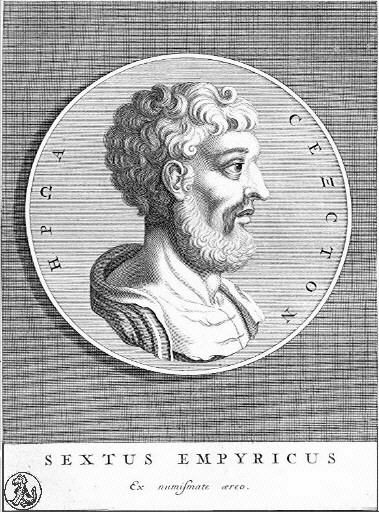
Skepticism is a philosophical attitude, not a philosophy. As an attitude, it is necessary and it consists in the unwillingness to accept anything as true or given or presumed beforehand. At the same time, this is not the primary objective of classic skepticism, whose goal was aligned with Stoicism and Epicureanism: peace of mind (ataraxia) from the ‘evils’ of the world.[2] We must start from the extreme form of it; that is, skepticism as a philosophy and not just as an attitude: “Sextus presents scepticism as a kind of philosophy, distinguished from others not by the content of its doctrines (there are none), but apparently by its attitude to philosophical problems and theses.”[3] According to this position, there is no solid foundation for any statement and proposition, no matter the origin, cause and formulation. The skeptical argument is the refuse of any possible argument at its extreme.
Reading Sextus Empiricus is an healthy reminder on how unconstructive is engaging with purely skeptical arguments as they have no purpose to arrive to any specific conclusion but that there is no conclusion or starting point.[4] Sextus does not care about finding principles, but only to show how the very pursuit in finding some is pointless. That’s his own premise and conclusion, his philosophy in a nutshell.
Sextus’ arguments are almost exclusively of two types. The first concerns the criticism of the undecidability of judgment (presumed to be such), where ‘judgment’ here means an evaluation of factual propositions (e.g., salt is salty for the healthy person but not salty for the sick). Typically, the criticism of the formulation of the judgment is made by assuming the existence of sensations (at time t1, salt appears salty; at time t2, salt appears sweet). This argument is intended to prevent any physical generalization based on senses (primarily neo-Aristotelian approaches to reality but also Stoics and Epicureans in different ways). More broadly, for any proposition p, there is no arbitrary way to ground in another statement p2 or in any non-linguistic grounding e. Sextus needs different arguments for both parts of this commitment. Unlike Descartes, he does not go beyond this first level of skepticism toward the senses because one can argue that though deceived by the specific sensation, one is not deceived by the presence of sensation as a category. Sextus probably is contented to show that, even with so little effort, it is already possible to question any further edifice of physics or natural philosophy.
One can start making the claim that to pose the senses under scrutiny, it must be assumed their existence and specific apprehension in the first place. How can Sextus be able to start a sentence about the senses without at least referring to some concrete sensations? Indeed, he does, he must. This is necessary unless Sextus uses those words only syntactically without any proper semantical value. Specifically, Sextus does not necessarily deny the meaning of those words but their reference: there is no such property as ‘salty’ as different subjects experience the sensation differently at different times. Hence, the external reference is denied. Sextus essentially assumes as obvious that both he and his readers can distinguish ‘sweet’ from ‘salty’ despite his conclusions. Otherwise, his argument itself makes no sense (but this conclusion, in turn, is negated by his own argumentative determination: he would be meaningless in general). But what about the meaning of the word ‘salty’?
Following my theory of meaning,[5] which assumes that the meaning of a word is the package of sense-data associated to a given word through memory and then used appropriately syntactically, we must assume that Sextus indeed learned the meaning of the word ‘salty’ because he showed it to us: he makes examples in which the word is used syntactically and semantically appropriately (the sentence is intelligible and can be questioned on their truth-value, that is, we can understand it). Therefore, to understand his argument, he needs to assume that we understand it. But how can he believe that considering what he is trying to do? This already shows that there is something peculiar about Sextus’ endeavor.
Assuming meaning of a word as the subjective rendering of a portion of reality identified by a subject through sense-data caused by an external event (object plus time), we understand Sextus’ first move better. He is cutting the circle between the reference of a given word and its meaning, moving away from reality. The argument is intended to remove the references of the words leaving intact their meaning. This is already an important victory, because it creates the conditions for believing that purely linguistic formulations of the world are spinning freely around without safe anchorage with the world – as the world, if there is one, is disputable and unintelligible. Then, the second move is indeed denying that there is any meaning at all.
We can see this at play with the word ‘salty’ and ‘sweet’. He starts indicating them, instantiating specific examples. Then, he poses that those two words are interchangeable so destroying their meaning (not their reference anymore – that was already done). However, to make this second move, a ‘boxing’ sidestep is required: he needs to deny any proper knowledge (justified true belief). He already denied truthfulness as a condition as there is no reality to speak of. Now, the turn is about the justification for a belief – as one can still believe that, pragmatically, we can make informed guesses on how the world looks like to us, the subjects. Kant was said to be somewhat aligned with Sextus in this sense, but it is not completely true as Kantian metaphysics is minimal but not inexistent: the existence of the subject and of something that goes beyond its categories are both assumed necessary for reason to work and Kant does not deny it, only he limits its extension.[6] But Sextus is not contented with this intermediate result or concession. He wants much more, denying any discussion, including epistemological conceptions of the subjective apprehension of the world.
Firstly, famously, he uses his logical argument to prove that any proper epistemological statement is always based on a vicious infinite regression or petitio principii. This prevents any logical deduction or stipulation, beyond the proof that Sextus uses to make his point. Likely, his argument is only destructive and intended to show that using flawed reasoning (that is, any reasoning) infallibly produces empty results. So, this is to prevent logical deductions to work. Not only does he deny the existence of reference and meaning, but he also denies the possibility of abstract pure deduction. In Quinean sense, we can say that Sextus also does not believe in analyticity.[7] For the moment, analyticity is denied not because words do not have any meaning but because the logical scaffolding of the pure argument semantic-independent does not even start because the principles of logic are self-defeating.
Secondly, he needs now to attack the other side, which is the notion of ‘meaning’ itself. As he already attacked the notion of sense-data acquisition, meaning cannot be based on any relation between a reference and the subject.[8] But we know that subjects talk through statements, hence we can presume they mean something. Pragmatically, we can regularly partially expect how they are going to behave according to those statements or we can accuse them of contrast between words and deeds, misdoings and ‘contradictions’ on those premises.[9] However, without connection to the world and without any logical scaffolding, their words are literally pointless. Can they be only figment of pure imagination that just flow from one another producing by chance some vocal results? Wittgenstein explicitly considered similar situations when he gave the example of a machine that produces wallpaper with some script up to it that is completely meaningless for the machine but not for us.[10] It is unclear if we can have an answer for what is left, but Sextus would be perfectly satisfied with this specific result. Meaning ceases to have any relation with reality and any argument ceases to have any reference and logical scaffolding.
At the same time, Sextus almost never seems to deny the existence of what we would call ‘ordinary facts’, such as ‘dogs have a sense of smell…’ He presupposes the presence of dogs and a certain property of dogs to exist in the world. Moreover, he never arrives to write down explicit contradictions such as ‘there are dogs, but dogs aren’t there’ at the same time and in the same sentence. This happens without changing the semantic register where ‘dogs’ first interprets the animal and then humans described derogatorily. The same applies to his ontology, which appears to be quite rich (moreover, stylistically I find it rather boring, reading long lists of how things are and aren’t!). This is reasonable and disappointing at the same time. It is reasonable because of Sextus’ own interest: destroying the premises of any philosophical edifice of sort, meanwhile not creating a new one. But there is an internal tension in his line of argument because constantly he needs to sketch linguistical constructions which, if we take him seriously, we cannot believe true or even meaningful at all. And his specific paradox is not only limited to the reassertion of ordinary facts for introducing his philosophical counterarguments. He also follows ‘logic’ quite seriously – as, after all, he needs to. He wants to prove Plato and the rest wrong, hence the proof must be given somehow, and this ‘somehow’ must be logical in nature, only then to show that there is no logic in the apparent use of logic.
First, he himself never goes so far as to deny the principle of non-contradiction. Second, and more importantly, he uses the entire (in)formal logical apparatus despite the fact – as already seen – that he wants to deny it. For example, his preferred argumentative style is the reductio ad absurdum, which requires (a) negation, (b) conjunction, (c) a principle of derivation, and (d) at least a semantic notion of contradiction (and this last notion is essential for him to overturn the ‘dogmatists’). As per (d), we are here explicitly just limiting to semantic notion of contradiction, but, as previously stated, he always tries to stay within the limits of syntactical contradiction. But he does not apply the same destructive logic to his own arguments. He accepts the rules of the game, and in fact, it seems to me that he doesn’t conceive his own arguments as dogmatic (a term that appears countless times in the English translation), if by ‘dogmatic’ we mean committed to defending an argument and its results. This is precisely because he cannot deny this: if his arguments were meaningless, then his goal of reassuring humanity from the torments of judgment (a goal declared at the very beginning) would be inexpressible, and even if it could be formulated, unattainable without suitable means. Therefore, in one case it would be irrational in accordance with the end, in another in accordance with the means. We can conclude that the goal is to defeat dogmatism and the means to achieve it is to sabotage language through systematic paradoxes whose solutions are denied by the previous act of sabotage.
Finally, following the traditional subdivision of philosophy in metaphysics, epistemology and ethics, Sextus attacks also the latter as pointless. In this case, however, he obviously bases his arguments on relativity of customs and rules of behavior and, in this sense, his all point is to show that different people behave differently etc..[11] However, all this demolition is not without explicit purpose, in his mind. Sextus still claims to have a solution to the same problems posed by the Stoics and Epicureans: ataraxia – I don’t know if Sextus uses these terms, but he claims his will to ‘relieve man from the problems of the dogmatists,’ as he says in the introduction. Hence, he accepts the common sense of the ethics of the time where the overarching strategic philosophical objective is diagnostic. But where the Stoics identified the causes of human diseases in unstructured fortune that creates all sorts of travesties to the human psyche, where the Epicureans identify the culprit in the pretense of human obsessive control, Sextus believes they are both wrong as all problems arise from the human appreciation for regularities and predictability.
Paradoxes and the Malevolent Use of Language and Why We Need It
Skeptical arguments are philosophically essential, and the entire edifice of any philosophical speculation must be grounded on them. Indeed, they always are. Any philosophical position is based on the rejection of a previous one or some portion of it and, if not, it is against something else. For example, Aristotle reformed the Platonic understanding of the duality of the world divided between abstract ideas (pure forms) and the world of appearances (matter). Plato and Parmenides denied in full or part the notion of appearances themselves. More recently, the entire analytic philosophy is grounded on the friction posed to natural language through specifically tailored counterarguments which are skeptical. For example, Gettier problems try to underline how the traditional definition of knowledge is insufficient.[12] Then, there is no question whether there is a space for skepticism as a philosophical attitude. Instead, we must be very skeptical about skepticism as a legitimate form of philosophy.
Sextus is not the best philosopher and exactly because of that, he shows better the mistakes that other more sophisticated thinkers could dissimulate. This is the case of certain Wittgensteinian positions as we cannot deny Wittgenstein’s profoundness. Hence, Sextus gives us the best and most traditional, clean version of skepticism as a positive philosophy.
All the skeptical arguments are based on the principle that natural language is empty in full or part. They start showing semantical shifts and the arbitrary of linguistic conventions. An excellent example is given by Wittgenstein when he points out that an arrow can point in two directions and there is no reason to establish which one. This could even undermine the notion of ostension, that is ‘This is an apple’ meanwhile pointing at one with the finger. However, we must concede that we learn language in this way and we can test the understanding of the proposition if we say ‘Please, give me that apple’ and this request is satisfied if and only if a person nearby gives us the desired object. So, in this sense, Wittgenstein and Sextus should give us an explanation for how this is possible without assuming the existence of an apple – whatever the notion of ‘existence’. They also need to explain why we have the expectation that the other person will understand us and why they are going to act and we can judge that act depending on the execution based on the propositional content of the request.
However, they can pretend to not have an answer to this, but they can argue that there is no reason for the person to ask for anything in particular. That is, they could not deny some form of external existence but only that there is no space of reason for pretending anything out of the linguistic act. But this is also denied by the execution of the request itself. Therefore, skeptical arguments are intended to sabotage language to deny its legitimacy as a space of reason elaboration – at the very least, but it is unclear whether this act of sabotage is achieved. For example, Wittgenstein was in this line of thinking in his Tractatus, exactly because he denies anything beyond perfect correspondence between language, thought and reality.[13] He was very specific in his skepticism but, again, he betrays the metaphysical contradiction as his own Tractatus is written in meta-propositions whose truth-value is absent etc. Here we can see the act of sabotage pursued against any philosophy that goes beyond ‘science’, that is, the discovery of truth about specific propositions about the world. Philosophy is without reference but not without meaning, if with ‘meaning’ we intend some form of value. So, denying philosophy as linguistically empty, he reinforces the opposite side of it. He does so in a very curious way: though science can be genuinely truthful, it could not be humanly meaningful. Philosophy is the opposite. It could be empty and meaningful at the same time. The question is how these statements can make any sense.
As reported, linguistic sabotage is an essential component of any general or local skeptical argument. The acts of sabotage are played through argument sketches intended to show the imperfection or inefficiency of a linguistic formulation then generalized. Then, the skeptical sabotage is played in different steps. First, they identify a target (e.g. knowledge through senses). Second, they introduce an example introduced linguistically (e.g. ‘I perceive a pizza as salty when I feel well but I perceive it as tasteless when I have a cold’). Third, they extrapolate a specific negation out of the example (e.g. ‘I cannot say if pizza is salty or tasteless’). Finally, they generalize the negation as a rule intended to disprove another one (e.g. ‘Taste is pointless’) which is meant to deny an entire category of arguments (e.g. ‘Any reasoning based on taste is pointless’). In this way, they think they have achieved their purpose. In Sextus’ arguments we can some parts of this structure, but he definitely means it all. In Wittgenstein’s variations we can see instead more subtle forms of meaning and referential shifting with much clearer end goal.
I do believe that this is both interesting and pointless at the same time. It is interesting and philosophically relevant as a means for further scrutiny, which was part of the anti-dogmatic attitude that both Sextus and Wittgenstein pursued. If localized, skeptical arguments must be taken seriously not because they prove anything specifically but because they beg the question on an important assumption we must justify somehow or reform. For example, I argue that even a very religious individual should be as skeptical as possible because skepticism is a form of applied rationality to portions of what we believe or think. As a result, skepticism about religion can smooth radicalism and unilateralism. For example, if we appreciate that there is no unique understanding of God/god/gods, we then must accept variety of interpretations without pretending uniqueness. Hence, Sextus is right in posing skepticism as a call for anti-dogmatism. However, if we go beyond this level and we pretend that nothing makes sense, then here we have a problem: the means used to prove this proposition are insufficient to make the claim. In the case of language, it is very healthy to always ask the question of whether the language aptly describes the world as the world is. At the same time, denying the very possibility is pointless.
All exaggerated skeptical philosophies are based on malevolent use of language to show that it does not work and will never work. How do they do it? We have already seen it technically but here specifically I want to investigate the intent. Radical skeptics start somewhat in bad faith as they already assume all people do not really understand each other as natural language and logics are groundless. They pretend to demonstrate this showing local imperfections of natural linguistic expressions concluding far too much from what they present. For example, posing skepticism on memory – how do we know that God didn’t create the world just one second ago, but they also insert on us fake memories about a past that never existed – seems to suggest that we cannot prove that memory exist. But metaphysically, the skeptical argument already introduced the existence of memory in the first place, independently on the existence of past. Secondly, this does not prove that memory does not work anyway. Thirdly, we cannot even conclude that, epistemologically, if God created the world in that curious way, we couldn’t claim that nothing has changed because a fake past is still a past. The change here is not on the notion of past but what we know about it. In other words, language is used with malevolent intent and then they conclude more than they can claim. But why should we start with such malevolent intent in the first place? If skepticism is useful, it is because there is no intent at all beyond a request for more evidence or analytic clarification over a portion of language. Not all language can be sabotaged at the same time as otherwise, again, the skeptical argument cannot even start.
In this sense, skepticism works only so far does not go beyond what it can claim and as an instrument for a greater good – the clarification of portions of our human understanding now under question.
Conclusions – Skepticism as a Process instead of an Object
There is no way we can be good at anything without being extremely skeptical about who we are, what we think and what we do. Skepticism as an attitude is simply too fundamental for being discharged because philosophers went too far in sabotaging. In fact, the best philosophy is produced through local skeptical arguments. Cartesian metaphysics and Kantian arguments are both grounded on systematic scrutiny of what we can and what we cannot legitimately state or defend. The hyperbolic Cartesian skepticism is intended to destroy the ‘old opinions’, which were, at that point, ungrounded. Similarly, Kant wants to reform our understanding of knowing in more specific terms specifically limiting the possible knowledge of the world. These are undeniably stories of philosophical achievements unthinkable without skeptical attitudes.
Even more so we can see in current discussions both extremes, as we all live in pre-modern discussions about the world at all levels. From one side, there is a resurgence of dogmatic attitudes from institutions whose legitimacy should be based on the public scrutiny of the flaws of reasoning being it scientifically or politically. Instead, we are constantly failing and sliding back different forms of ungranted beliefs about who we are and what we do. We are back to an unchecked relativism radicalized by multiple forms of unilateral dogmatism whose strength resides in their complete lack of justification. They need to escalate unilateralism exactly because, as any unchecked and unskeptical faith, wins with the instrument of war: sheer imposition of strength to force the reluctant will to follow the right spell. This is the tragedy of our time where everything seems possible and, at the same time, unprovable. Relativism plus dogmatism is a far worst act of sabotage of human understanding and flourishing that any skeptical argument.
Therefore, we need and must be procedural skeptics. We need to go back to inquire what we do believe, what we do and why, otherwise we are doomed to a long period of ‘neo-religious wars’ whose only result is blood being spelled around the world in name of false justified beliefs. We need to put as much friction as possible into what we think we believe and we don’t understand. Skepticism is a fundamental philosophical instrument and renouncing it brings misdoings and tragedies. We are already there and Sextus would look at us in despair. But sometimes humanity simply does have to learn the same lessons again, even assuming that parts of them are wrong. Some paths do not go anywhere and, yet, they make us better.
[1] I had many conversations with a dear friend of mine about this topic and, now that I cannot talk to him very often, I remember those moments with great appreciation and fondness. We confronted on Wittgenstein’s philosophy of mathematics and we discussed Sextus Empiricus at length. Indeed, in 2022 I read Sextus only as a follow up of those conversations… only five years later.
[2] Pili, G., (2022), “Gli Stoici – Felicità come armonia dell’anima”, Scuola Filosofica, available at: https://www.scuolafilosofica.com/11293/stoici-e-la-felicita, Pili, G., (2022), “Epicuro – Felicità tra assenza di dolore e pace dell’anima”, Scuola Filosofica, available at: https://www.scuolafilosofica.com/11280/felicita-epicurea
[3] Morison, Benjamin, “Sextus Empiricus”, The Stanford Encyclopedia of Philosophy (Fall 2019 Edition), Edward N. Zalta (ed.), URL = https://plato.stanford.edu/archives/fall2019/entries/sextus-empiricus/
[4] This is not unique of the Western philosophy and it seems a general need for some thinkers to get rid off the burden of dogmatic attitudes toward reality. For example, Zen Buddhism is often claimed to go in the same direction as its collections of statements are intended to mine the very foundation of language – as we will see, a key component of Sextus’ philosophy.
[5] Pili, G., (2025), “Memory, Meanings and Language – How We Think About Things”, Scuola Filosofica, available at: https://www.scuolafilosofica.com/12854/memory-meanings-and-language
[6] Pili, G., (2019), “Capire la Critica della Ragoin Pura”, Scuola Filosofica, available at: https://www.academia.edu/38740822/Capire_la_Critica_della_ragion_pura_di_Immanuel_Kant and Pili, G., “La potenza della ragione secondo Kant”, Scuola Filosofica, available at: https://www.scuolafilosofica.com/9815/potenza-della-ragione-kant
[7] Quine, W. (1976). “Two dogmas of empiricism.” In Can Theories be Refuted? Essays on the Duhem-Quine Thesis (pp. 41-64). Dordrecht: Springer Netherlands.
[8] I appreciate that this is a specific notion of meaning based on a causalist understanding of it. However, I think changing the justification for the existence of semantics wouldn’t change the result.
[9] Pili, G., (2021), “The Principle of Transposition – The Untold Story about History”, Scuola Filosofica, available at: https://www.scuolafilosofica.com/11042/principle-of-transposition
[10] The example was likely inspired by the looms which indeed can create words onto a t-shirt without them knowing the meaning of those words.
[11] This obviously doesn’t prove that all different behaviors are equally good or healthy, but he doesn’t care.
[12] Pili, G., (2011), “Edmund Gettier – La conoscenza è la credenza vera giustificata?”, Scuola Filosofica, available at: https://www.scuolafilosofica.com/566/gettier-e-la-conoscenza-e-la-credenza-vera-giustificata, Gettier, E. (2020). “Is justified true belief knowledge?” In Arguing about knowledge, London:Routledge (pp. 14-15).
[13] Wittenstein, L., (2021). Tractatus Logico Philosophicus. Simon and Schuster.

Giangiuseppe Pili

Be First to Comment